Long COVID Blood Clots: Ordinary Clots vs Microclots Explained
Short answer
Long COVID blood clots are two different questions. Ordinary clots (DVT, pulmonary embolism, heart attack, stroke) are more common after COVID-19, with the highest risk in the first weeks and a smaller excess lasting up to about a year in large cohort studies. Microclots are research particles seen in some Long COVID plasma samples. Their meaning is disputed.
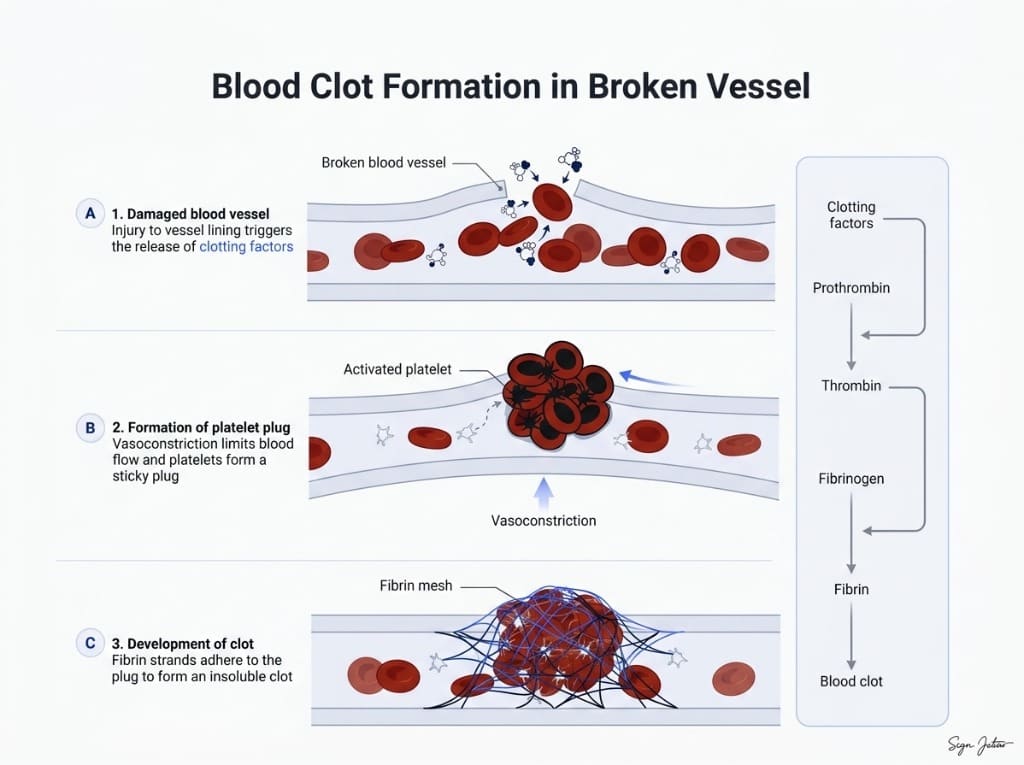
Key takeaways
- 1After COVID-19, the risk of an ordinary clot is highest in the first weeks, then falls, but stayed slightly raised up to week 49 in an English and Welsh study of 48 million adults.
- 2The excess risk is higher and lasts longer after a hospital stay for COVID-19 than after milder illness, and the absolute risk for any one person is small.
- 3Microclots are fluorescent particles found in plasma in research labs. They aren't the same as a DVT or pulmonary embolism and have no validated clinical test.
- 4Some Long COVID patients have raised clotting and blood-vessel markers, such as a high VWF/ADAMTS13 ratio, but these studies don't prove clots cause the symptoms.
- 5Guidelines don't recommend blood thinners for people with mild COVID-19 or for routine use after hospital discharge. Whether to take one is a decision for your clinician.
Long COVID blood clots are really two separate questions: whether COVID-19 raises the risk of ordinary clots in the legs, lungs, heart and brain, and what "microclots" are. The first has solid answers from very large studies. The second is a research finding whose meaning is still disputed.
Does COVID-19 raise the risk of ordinary blood clots?
Yes, mostly early on. In a Swedish registry study of 1,057,174 people who tested positive between February 2020 and May 2021, matched to 4,076,342 controls, risk of deep vein thrombosis, pulmonary embolism and bleeding was higher in the 30 days after infection. The risk ratios were 4.98 for DVT and 33.05 for pulmonary embolism. In absolute terms, that was 0.039% for DVT and 0.17% for pulmonary embolism among the infected group over that window.
Rates were highest in people with critical COVID-19 and in the first pandemic wave. The study also looked at how long the excess lasted, which is the next question.
How long after COVID-19 do blood clots stay a risk?
The relative risk falls quickly, but it can take months to reach normal. In the Swedish study, incidence rate ratios stayed significantly raised for up to 70 days for DVT and 110 days for pulmonary embolism. A study of 48 million adults in England and Wales followed people to 49 weeks. The adjusted hazard ratio for a first arterial clot fell from 21.7 in week 1 to 1.34 in weeks 27 to 49, and for a first venous clot from 33.2 to 1.80.
Those authors estimated whole-population increases of 0.5% for arterial and 0.25% for venous events at 49 weeks, or about 7,200 and 3,500 extra events after 1.4 million diagnoses. A US Veterans Affairs study of 153,760 people with COVID-19 looked only at the period after day 30. It found pulmonary embolism at 2.93 times and DVT at 2.09 times the risk of controls over a year, and the excess was seen even in people who weren't hospitalised.
Long COVID clotting issues: the two ideas side by side
| Ordinary blood clots (DVT, pulmonary embolism, arterial events) | Microclots (research particles) | |
|---|---|---|
| What | Clots that block veins or arteries | Microscopic fibrin(ogen) particles stained in plasma in the lab |
| Evidence | Several national cohorts of millions of people | Small laboratory studies; one independent study found no difference |
| How long | Risk highest in the first weeks; a smaller excess up to about 49 weeks | Not established; we found no published time course |
| Who is at higher risk | People hospitalised or critically ill; in the English and Welsh study, relative risk was also higher in Black or Asian people and in people without a prior clot | Not established; healthy controls also show particles in some studies |
| How it's checked | Ultrasound, CT scan, standard blood tests such as D-dimer | Research fluorescence microscopy or flow cytometry; no validated clinical test |
For the clot-versus-microclot distinction, see microclots vs blood clots and the D-dimer vs microclot test comparison.
What are microclots, and how solid is the evidence?
In 2021, Pretorius and colleagues reported abnormal clotting-protein deposits in plasma from 11 Long COVID patients, compared with 15 acute COVID-19, 10 type 2 diabetes and 13 healthy samples. It was a small laboratory study. Our definition of microclots and the review of amyloid microclots and Long COVID cover what has been reported since.
The pushback is real. The 2023 Cochrane review judged the laboratory evidence insufficient to link the particles to post-COVID condition. A 2026 UK study of never-hospitalised Long COVID, published in HemaSphere, reported no hypercoagulability or increase in fibrin(ogen) microaggregates. We found no published trial showing that removing microclots helps.
Do Long COVID patients have clotting abnormalities on blood tests?
Some do, in cohort studies. Fogarty and colleagues studied 50 patients at a median of 68 days after infection. Thrombin generation was higher than in controls, and markers of endothelial (blood-vessel lining) activation, including von Willebrand factor (VWF), were raised.
A Blood Advances study of 276 patients in a post-COVID clinic found a VWF/ADAMTS13 ratio of 1.5 or higher in nearly one-third. Of 56 patients (20%) with impaired exercise capacity, 31 (55%) had that ratio. These are associations in clinic cohorts. They don't show that clots cause fatigue or breathlessness, and a clinician has to interpret them.
Next step
Curious about microclot-type particles in your own sample?
Our at-home amyloid fibrin test provides observational microscopy data to discuss with your clinician. It isn't a diagnosis.
Can Long COVID cause blood clots in the lungs or legs?
Ordinary clots in both places are linked to COVID-19, as the cohort data above show. Pulmonary embolism had the largest relative increase in the Swedish study. Microclots in the lungs and legs are a separate hypothesis, covered in microclots in the lungs and microclots in the legs. The two shouldn't be confused: a normal scan for a large clot doesn't rule out the microclot hypothesis, and a microclot result doesn't rule out a real DVT.
What do guidelines say about blood thinners after COVID-19?
They don't recommend them for most people recovering at home. The Anticoagulation Forum's 2022 guidance recommends against specific preventive antithrombotic therapy for non-hospitalised adults with mild COVID-19 and no other indication, and says people already on such medicine should usually continue it. It noted that in the ACTIV-4b trial of non-hospitalised patients, event rates were low, 0.7% to 1.4% across groups.
The American Society of Hematology's 2025 living guideline made a conditional recommendation suggesting against routine anticoagulant prophylaxis after hospital discharge, based on low or very low certainty evidence. We found nothing in these guidelines supporting blood thinners for Long COVID symptoms alone. Our pages on triple therapy for Long COVID and how dangerous microclots are cover the unproven side.
Which symptoms need emergency care?
Don't wait for a test. The NHS lists these as reasons to get emergency help straight away: sudden difficulty breathing, chest or upper back pain, a very fast heartbeat or collapse, which could be a pulmonary embolism. Call emergency services. A painful, swollen leg (usually the calf) with breathlessness or chest pain is also an emergency. Without those, DVT symptoms such as throbbing pain and swelling in one leg still need an urgent medical appointment.
Call emergency services too for signs of a heart attack, such as crushing or squeezing chest pain that may spread to the arm, neck or jaw, or a stroke, such as face drooping, arm weakness, slurred speech or sudden confusion. These apply whatever any microclot result says.
Questions to ask your doctor
- Is anything in my history (hospital stay, past clot, surgery, family history) putting me at higher clot risk?
- Should my breathlessness or leg symptoms be checked for a clot with imaging or standard blood tests?
- Would a VWF, D-dimer or other clotting blood test change what you'd do for me?
- Is it safe for me to take, or stop, any blood thinner or supplement I'm already using?
- If my symptoms persist, which other causes should we rule out first?
Where an at-home test fits
Our at-home amyloid test is a finger-prick dried blood sample, stained with Thioflavin T and imaged at a partner laboratory in Mexico City. The at-home microclot test report counts the glowing shapes and measures their size. It's not a diagnosis and not a medical device, and it doesn't check for DVT or pulmonary embolism. It also hasn't been validated against the venous platelet-poor-plasma research method, and there's no promise that a result changes care. To see how the method works, read how to test for microclots.
Frequently asked questions
Does Long COVID cause blood clots?
COVID-19 raises the risk of ordinary blood clots, mainly in the first weeks, and a smaller excess has been reported for months afterwards. That's different from Long COVID symptoms themselves. Whether tiny microclots cause Long COVID symptoms is still a research question, and critics, including a 2023 Cochrane review, say the evidence is insufficient.
How long after COVID-19 can you get a blood clot?
The risk is highest in the first week or two. In a Swedish study of over 1 million infected people, deep vein thrombosis rates were raised for up to 70 days and pulmonary embolism for up to 110 days. An English and Welsh study found a small excess of arterial and venous clots up to 49 weeks after diagnosis.
Can Long COVID cause blood clots in the lungs?
COVID-19 is linked to more pulmonary embolisms, which are large clots that reach the lungs. In a US veterans study, the risk was still about 2.9 times higher than in controls after the first 30 days. Microclots in the lungs are a separate, unproven idea. Sudden breathlessness or chest pain needs emergency care.
Is a microclot the same as a blood clot?
No. A DVT or pulmonary embolism is a large clot that imaging can find and standard treatment can address. Microclots are microscopic fibrin(ogen) particles stained in plasma in research studies. Critics argue they shouldn't be called clots at all. No standard blood test, D-dimer included, is validated to detect them.
Should I take a blood thinner for Long COVID?
Not on the strength of Long COVID alone. Guidance from the Anticoagulation Forum recommends against preventive blood thinners for people with mild COVID-19 and no other reason to take one, and the American Society of Hematology suggests against routine use after hospital discharge. Your clinician weighs your own clot and bleeding risks.
Sources
- Risks of deep vein thrombosis, pulmonary embolism, and bleeding after covid-19: nationwide self-controlled cases series and matched cohort study. BMJ, 2022
- Association of COVID-19 With Major Arterial and Venous Thrombotic Diseases: A Population-Wide Cohort Study of 48 Million Adults in England and Wales. Circulation, 2022
- Long-term cardiovascular outcomes of COVID-19. Nature Medicine, 2022
- Impaired exercise capacity in post-COVID-19 syndrome: the role of VWF-ADAMTS13 axis. Blood Advances, 2022
- Persistent endotheliopathy in the pathogenesis of long COVID syndrome. Journal of Thrombosis and Haemostasis, 2021
- Persistent clotting protein pathology in Long COVID/Post-Acute Sequelae of COVID-19 (PASC) is accompanied by increased levels of antiplasmin. Cardiovascular Diabetology, 2021
- Plasmapheresis to remove amyloid fibrin(ogen) particles for treating the post-COVID-19 condition. Cochrane Database of Systematic Reviews, 2023
- No evidence of hypercoagulability, altered fibrinolysis, or increased fibrin(ogen) microaggregates in never-hospitalized long COVID. HemaSphere, 2026
- American Society of Hematology living guidelines on use of anticoagulation for thromboprophylaxis for patients with COVID-19: executive summary. Blood Advances, 2025
- Thromboembolic prevention and anticoagulant therapy during the COVID-19 pandemic: updated clinical guidance from the anticoagulation forum. Journal of Thrombosis and Thrombolysis, 2022
- Pulmonary embolism. NHS, 2026
- DVT (deep vein thrombosis). NHS, 2026
- Heart attack. NHS, 2026
- Symptoms of a stroke. NHS, 2024
At-Home Amyloid Test
Curious about microclot-type particles in your own sample?
Our at-home amyloid fibrin test provides observational microscopy data to discuss with your clinician. It isn't a diagnosis.
Next steps
- Does Long COVID Show Up on Blood Tests? What Routine Labs MissDoes long COVID show up on blood tests? Usually not on routine labs. What research tests look at, plus a UK section on NHS and private options.
- Amyloid Microclots and Long COVID: What the Research ShowsAmyloid microclots and long COVID in plain language: what the key papers found, how spike protein may be involved, and what Cochrane says is still open.
- Living With Long COVID: A Practical Survival Guide for Right NowA practical guide to living with Long COVID: what's known, what isn't, how to pace and track symptoms, red flags, and how to get more from appointments.

Tim Ottowitz
Founder & Research Lead
Tim Ottowitz founded Amyloid Test and writes its Science Hub, turning fibrin amyloid and spike protein research into plain-language guides that stay close to the published evidence.
Keep reading
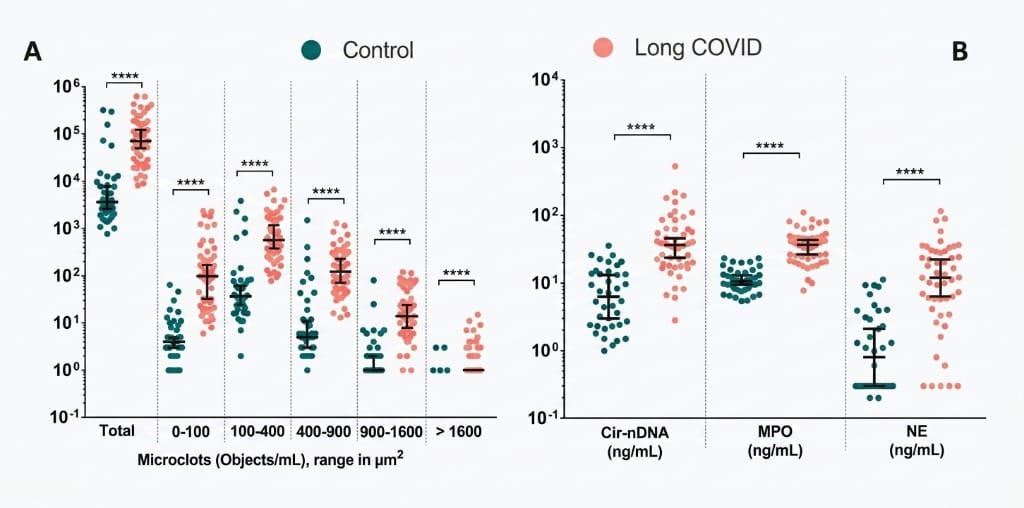
Micro Clots in Legs, Fingers and Toes: What's Known
Micro clots in legs: how to tell a DVT from superficial phlebitis, COVID toes and Long COVID microclots, and what research does and doesn't show.
Microclots in Lungs: Three Different Things, One Emergency
Microclots in lungs can mean a pulmonary embolism, autopsy microthrombi or plasma microclots. See what studies show, which symptoms need urgent care.

Microclots Treatment: Every Approach Studied and the Evidence
Microclots treatment compared in one table: anticoagulants, aspirin, nattokinase, apheresis, DNase and ultrasound, with the evidence and risks of each.