What Are Microclots? A Plain-Language Guide to Amyloid Microclots
Short answer
Microclots are tiny clots, far smaller than the clots behind a stroke or DVT. In research on Long COVID and other inflammatory conditions, the term usually means fibrin amyloid microclots: particles where the clotting protein fibrin has folded into an amyloid-like shape that resists normal breakdown. Researchers propose they may block small vessels and reduce oxygen delivery, but that link to symptoms is still being tested.
Key takeaways
- 1Microclots are microscopic clot particles; in current research the term mostly refers to fibrin amyloid (fibrinaloid) microclots.
- 2They form when fibrin folds into a beta-sheet-rich amyloid shape that binds Thioflavin T and resists the clot-dissolving enzyme plasmin.
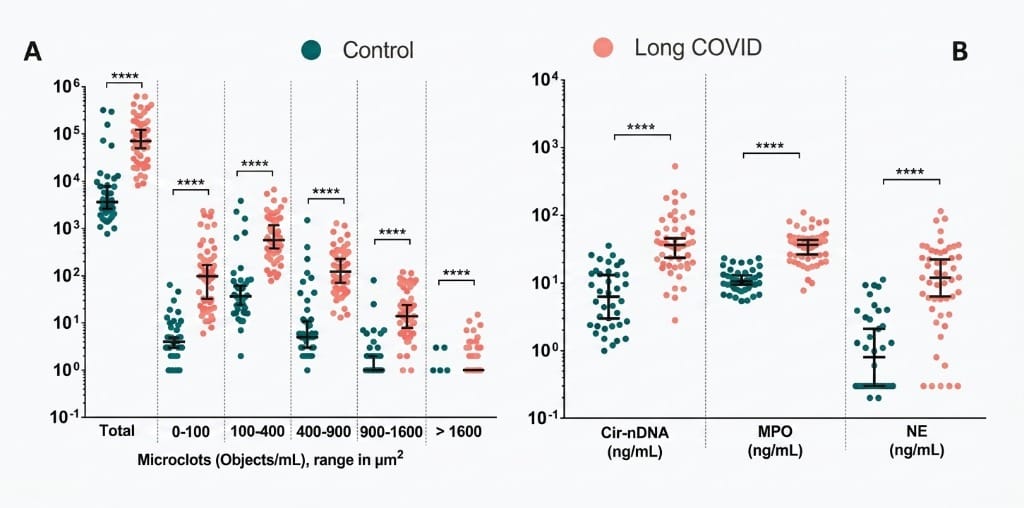
- 3Studies have found more of them in Long COVID plasma than in healthy controls, along with trapped inflammatory proteins.
- 4Fatigue, brain fog and exercise intolerance are proposed consequences, but causation hasn't been proven.
- 5Standard clotting tests don't see them; testing relies on fluorescence imaging.
"Microclots" went from a niche research term to a common Long COVID search in a couple of years. This guide explains what they are in plain language, how they form, which symptoms researchers connect to them, and what's still unproven. It's written for patients, but clinicians new to the topic should find it a quick orientation.
What are microclots?
A microclot is a clot too small to see without a microscope. Your body forms and clears tiny clots all the time, and that's normal. When researchers talk about microclots in Long COVID, though, they usually mean something more specific: fibrin amyloid microclots, also called fibrinaloid or amyloid microclots.
These are particles of fibrin, the protein that forms the mesh of a normal clot, that have folded into an amyloid-like structure. In a 2022 review, Pretorius, Kell and colleagues described how fibrinogen can clot into this anomalous amyloid form, which is relatively resistant to the body's clot-dissolving system. The research behind those findings is summarized in amyloid microclots: what the research shows.
| Normal clot | Fibrin amyloid microclot | |
|---|---|---|
| Size | Visible; can block a vein or artery | Microscopic |
| Structure | Loose fibrin mesh | Dense, beta-sheet-rich amyloid form |
| Breakdown | Dissolved by plasmin after healing | Resists plasmin in lab tests |
| Detected by | Ultrasound, CT, D-dimer | Thioflavin T fluorescence imaging |
| Clinical status | Well understood | Research stage, debated |
How do microclots form?
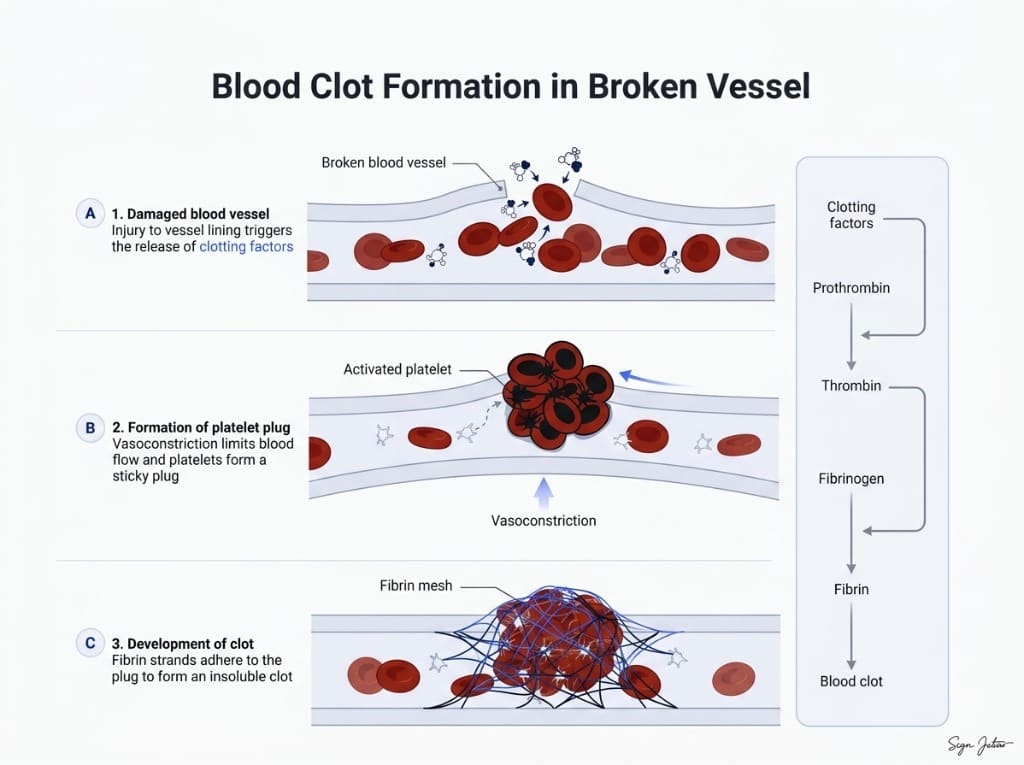
Normal clotting is a two-step cycle. Thrombin turns soluble fibrinogen into fibrin strands that knit together, then plasmin breaks the mesh down once the job's done. Microclots form when that cycle goes wrong in two ways at once.
The fibrin misfolds. Under inflammatory conditions, fibrin can take on an amyloid shape. In the lab, adding isolated SARS-CoV-2 spike protein S1 to healthy plasma changed the structure of the resulting clots and made them harder to digest. That was a test-tube experiment, not a measurement in patients, but it suggested one route.
The breakdown stalls. A 2021 study of Long COVID plasma found the microclots contained raised levels of α2-antiplasmin, a natural brake on clot breakdown. A later proteomics study found more inflammatory molecules trapped inside, including von Willebrand factor and platelet factor 4.
Immune cells may be involved too. A 2025 study reported that circulating microclots are structurally associated with neutrophil extracellular traps, the DNA webs that neutrophils release, and that both were raised in Long COVID. Our article on microclots and NETs in Long COVID goes into that link.
What are the symptoms of microclots?
There isn't a symptom list unique to microclots, and anyone who offers one is overselling the evidence. What researchers propose is a mechanism. If amyloid microclots lodge in capillaries, they could reduce oxygen delivery to tissues. The Pretorius and Kell review argues this could contribute to symptoms common in Long COVID:
- Fatigue and post-exertional malaise
- Brain fog and trouble concentrating
- Breathlessness
- Muscle and joint pain
- Exercise intolerance
Every one of these has other possible causes. A 2023 review of Long COVID in Nature Reviews Microbiology lists clotting and endothelial problems as one of several proposed mechanisms, alongside viral persistence, autoimmunity and reactivated viruses. Microclots may be part of the picture for some people, all of it for none, or a marker rather than a cause. Our plain-language guide to microclots and Long COVID covers how this fits with the other theories.
Who gets microclots?
Most of the published data come from three groups:
- People with Long COVID, where the most research has been done.
- People with persistent symptoms after vaccination, a smaller and newer area. Our article on post-vaccination microclots covers what's been published.
- People with chronic inflammatory conditions such as type 2 diabetes, where the same group described amyloid fibrin before the pandemic.
Some healthy controls show low levels too. That's one reason researchers treat microclots as a sign of an inflamed clotting system rather than a marker of any single disease.
Is the microclot theory proven?
No, and it's worth being straight about that. The evidence so far is observational, comes mostly from one research network, and uses methods without an agreed cutoff.
In 2024, haematologists led by Beverley Hunt published a critique of the microclot hypothesis. They argued the conclusions went beyond the evidence and that unlicensed anticoagulant use and apheresis shouldn't be offered outside trials. Kell, Khan and Pretorius published a reply defending their data. Both sides agree on one thing: properly controlled trials are needed.
Next step
Curious whether microclots show up in your blood?
Our at-home amyloid fibrin test stains your sample with Thioflavin T and records video microscopy you can share with your doctor.
See the at-home testHow are microclots detected?
Standard clotting tests can't see them. D-dimer measures fragments released when clots dissolve, which is a different question, as we explain in D-dimer vs microclot test.
Detection relies on Thioflavin T, a dye that glows when it binds amyloid. A stained blood or plasma sample is imaged under a fluorescence microscope or run through an imaging flow cytometer. Our step-by-step guide on how to test for microclots compares the methods and where to get them, and the amyloid fibrin test pillar explains the staining method in detail.
If you'd rather test from home, our at-home amyloid test uses a finger-prick dried blood sample stained with Thioflavin T and returns a Videographic Microscopy Report. It isn't a diagnosis. It gives you observational data to review with your doctor.
Can microclots be treated?
Several approaches are being studied, including enzyme supplements like nattokinase, anticoagulant combinations and apheresis. None has been proven in a large randomized trial for microclots, and anything that affects clotting carries bleeding risk. Our review of nattokinase and lumbrokinase for microclots sets out what the evidence actually shows.
Don't start or stop blood thinners on your own. If you're looking for a clinician who knows this research, our doctor directory is a place to start.
Where to go next
For the research in more depth, read amyloid microclots: what the research shows. If you're ready to look at testing, start with how to test for microclots.
Frequently asked questions
Are microclots the same as blood clots?
They're related but not the same. A typical blood clot, like one in a deep vein, is large enough to block a vein and can show up on ultrasound. Microclots are microscopic particles seen only under a microscope. The fibrin amyloid microclots in Long COVID research also differ in structure: they've folded into an amyloid-like form that resists the normal clot-dissolving process.
What are the symptoms of microclots?
There's no symptom list that's specific to microclots. Researchers propose that if microclots block capillaries, they could reduce oxygen delivery to tissues and contribute to fatigue, brain fog, breathlessness, muscle pain and post-exertional symptoms common in Long COVID. Those symptoms have many possible causes, so they can't tell you whether you have microclots.
Can microclots go away on their own?
Nobody knows yet. There are no long follow-up studies tracking microclot levels in the same people over months or years without treatment. Normal fibrin clots are cleared constantly by the body, but the research describes amyloid microclots as resistant to that process. Whether they clear slowly, persist or keep forming while inflammation continues is an open question.
Are microclots dangerous?
Microclots aren't the same as a clot that causes a stroke or pulmonary embolism, and they aren't an emergency on their own. Their importance is in what they might do over time, such as interfering with blood flow in small vessels, and that's still under study. Sudden chest pain, sudden breathlessness, leg swelling or stroke symptoms need emergency care whatever your microclot status.
Who first described amyloid microclots?
Resia Pretorius at Stellenbosch University and Douglas Kell at the University of Liverpool described amyloid forms of fibrin in conditions like type 2 diabetes before the pandemic. From 2021 they applied the same methods to COVID-19 and Long COVID plasma. They coined fibrinaloid as shorthand for fibrin in an amyloid form.
Sources
- A central role for amyloid fibrin microclots in long COVID/PASC: origins and therapeutic implications. Biochemical Journal, 2022
- Persistent clotting protein pathology in Long COVID/Post-Acute Sequelae of COVID-19 (PASC) is accompanied by increased levels of antiplasmin. Cardiovascular Diabetology, 2021
- Proteomics of fibrin amyloid microclots in long COVID/PASC shows many entrapped pro-inflammatory molecules that may also contribute to a failed fibrinolytic system. Cardiovascular Diabetology, 2022
- SARS-CoV-2 spike protein S1 induces fibrin(ogen) resistant to fibrinolysis: implications for microclot formation in COVID-19. Bioscience Reports, 2021
- Circulating Microclots Are Structurally Associated With Neutrophil Extracellular Traps and Their Amounts Are Elevated in Long COVID Patients. Journal of Medical Virology, 2025
- Long COVID: major findings, mechanisms and recommendations. Nature Reviews Microbiology, 2023
- Challenging the current hypothesis that thrombosis is responsible for the post-COVID-19 condition. Research and Practice in Thrombosis and Haemostasis, 2024
- Fibrinaloid microclots in long COVID: assessing the actual evidence properly. Research and Practice in Thrombosis and Haemostasis, 2024
At-Home Amyloid Test
Curious whether microclots show up in your blood?
Our at-home amyloid fibrin test stains your sample with Thioflavin T and records video microscopy you can share with your doctor.
Next steps
- How to Test for Microclots: Methods, Options and What Results MeanHow to test for microclots: the methods researchers use, why D-dimer can't detect them, where to get a microclot test and how to read the result.
- Amyloid Fibrin Test: How Fibrin Amyloid Microclots Are DetectedWhat an amyloid fibrin test is, how Thioflavin T microscopy spots fibrin amyloid microclots, how it differs from D-dimer, and what it can't tell you.
- Microclots and Long COVID: A Plain-Language Guide to Amyloid ClotsMicroclots and Long COVID explained simply: what amyloid fibrin microclots are, how spike protein may be involved, what's proven and what's still open.

Tim Ottowitz
Founder & Research Lead
Tim Ottowitz founded Amyloid Test and writes its Science Hub, turning fibrin amyloid and spike protein research into plain-language guides that stay close to the published evidence.
Keep reading
Amyloid Microclots: What the Research Shows So Far
What studies show about amyloid microclots in Long COVID: how fibrin forms them, why they resist breakdown, the key findings and the open questions.
D-Dimer vs Microclot Test: Why a Normal D-Dimer Can Miss Microclots
D-dimer vs microclot test compared: what each measures, why D-dimer can read normal in Long COVID, and how Thioflavin T microscopy finds fibrin amyloid.
Neutrophil Extracellular Traps in Long COVID: The Microclot-NET Study
A 2025 study found neutrophil extracellular traps tangled into microclots in Long COVID. What the paper measured, what it found, and what it can't prove.