Microclots and Long COVID: A Plain-Language Guide to Amyloid Clots
Short answer
Microclots are tiny clumps of the clotting protein fibrin that have folded into a tough, amyloid-like shape. Researchers have found more of them in blood from people with Long COVID than in healthy people, and lab work suggests the SARS-CoV-2 spike protein can help form them. They resist the body's normal clean-up, but whether they cause Long COVID symptoms isn't proven yet.
Key takeaways
- 1Microclots are small clumps of fibrin folded into an abnormal, amyloid-like shape that's hard for the body to clear.
- 2Small studies found more of them in Long COVID blood samples than in healthy controls.
- 3Lab experiments show parts of the spike protein can form amyloid and make fibrin harder to break down.
- 4Routine clotting tests don't look for these particles, so normal results don't settle the question.
- 5Microclots may matter a lot for some people and little for others; the science is still being worked out.
This guide is for anyone who's heard the word "microclots" and wants a clear explanation without the jargon. By the end you'll know what microclots are, why researchers think they might matter in Long COVID, and which parts of the story are solid versus still being tested.
What are microclots?
Microclots are tiny clumps of fibrin, the protein your body uses to build blood clots, that have folded into an unusual, amyloid-like shape. That shape makes them stickier, denser and much harder for the body to clear. Our guide to what microclots are covers how they form and which symptoms researchers link to them.
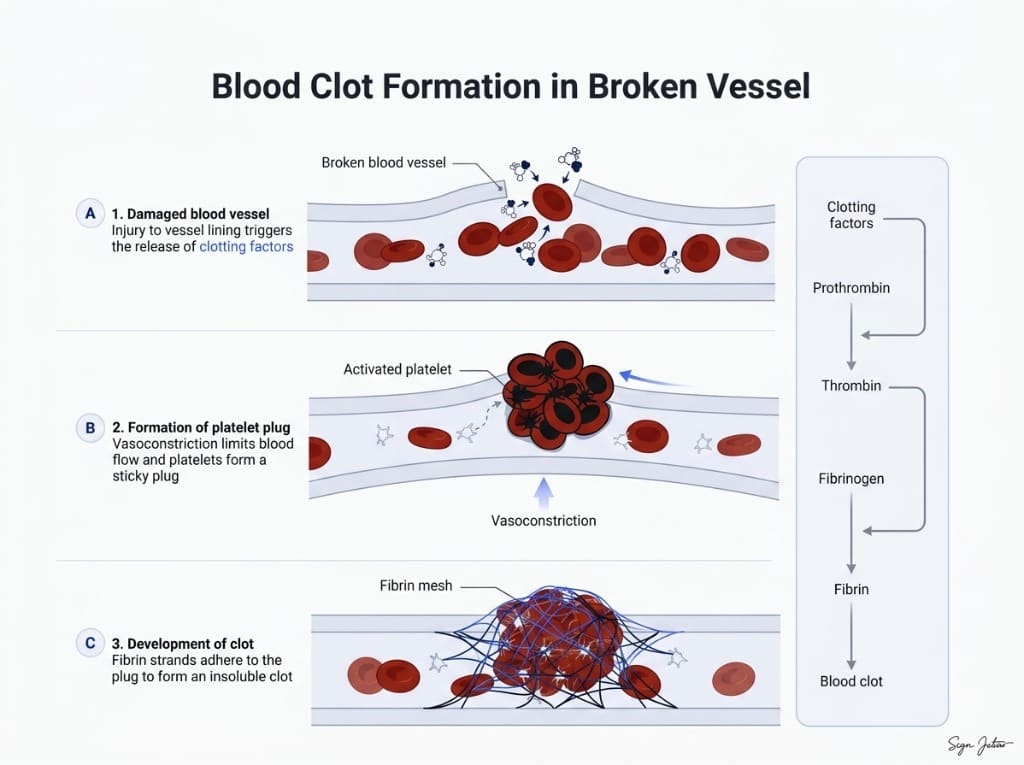
Think of your blood as a river. When you're injured, your body throws a temporary net across the wound, then cuts it apart once the job's done. Microclots are like nets that came out twisted and sticky, so the scissors can't cut them.
What "amyloid" means
Amyloid isn't one substance. It's a way proteins can misfold, stacking into rigid sheets that clump together and resist being broken down.
- A healthy protein is like a shirt folded neatly in a drawer.
- An amyloid-like protein is like a shirt twisted up, damp and stuck to five other shirts.
- The more they stick together, the harder the mess is to clean up.
Amyloid isn't always harmful. The body uses some amyloid structures on purpose, including as part of immune defence, which our article on amyloid beta as an immune defense explores.
Why fibrin matters
Fibrin is made from fibrinogen, a protein that circulates in everyone's blood. Normally the body follows three steps: spot damage, build a temporary patch, then dissolve the patch with an enzyme called plasmin. That dissolving process is called fibrinolysis.
Microclots are a problem in step three. In lab studies, the amyloid-like fibrin in Long COVID samples resisted fibrinolysis and trapped proteins that block plasmin (Pretorius et al., 2021). The detailed findings are summarized in fibrin amyloid microclots research.
Why would tiny clots matter for blood flow?
Your smallest blood vessels, capillaries, are only about 5 to 10 micrometres wide. Many microclots are that size or larger (Kell et al., 2022). Scans that find big clots can't see particles this small.
Picture a city where the highways are open but thousands of side streets are partly blocked. Deliveries still arrive, just slower and less reliably. The hypothesis is that if enough capillaries are affected, oxygen delivery to muscles and the brain could drop, which might feed fatigue and brain fog. That's a proposal, not a proven mechanism.
What the glowing microscope pictures show
Researchers add a dye called Thioflavin T to blood plasma. It sticks to amyloid-shaped material and glows under the right light. More glowing clumps suggests more amyloid-like fibrin in the sample.
In published studies, plasma from people with Long COVID showed more and larger glowing deposits than plasma from healthy controls (Pretorius et al., 2021). A bright image is a reason to look further, not proof of what's causing someone's symptoms. If you're curious how the stain works, the amyloid fibril test guide explains it.
Where does the spike protein fit in?
Lab experiments at Linköping University showed that fragments of the SARS-CoV-2 spike protein can form amyloid fibrils on their own (Nyström and Hammarström, 2022). Later work from the same group found that these spike amyloid fibrils changed how fibrin formed and made clots harder to dissolve (Westman et al., 2025).
In plain terms: spike fragments may be present, they may interact with clotting proteins, and the resulting clot may be tougher to clear. All of this comes from test-tube work. The fuller story is in spike protein amyloid fibrils and fibrinolysis.
Clinical next step
Want to see what your own blood sample shows?
Explore our at-home amyloid fibrin test and discuss the report with a qualified clinician.
Start screeningWhat has actually been shown so far
It helps to sort the evidence by where it comes from.
In the lab
- Certain spike protein fragments can form amyloid-like fibrils.
- Spike amyloid can make fibrin clots that resist breakdown.
- Amyloid dyes light up these structures in blood-derived samples.
In patients
- Some people with Long COVID show more amyloid-like microclot material than healthy controls.
- In some small studies, higher microclot burden went with worse symptoms.
- Standard clotting tests often don't reflect these structural changes, as explained in D-dimer vs microclot testing.
Still unresolved
- How common this is across everyone with Long COVID.
- Whether microclots drive symptoms or are one sign of a wider injury.
- Which tests are reliable enough for routine clinical use.
- Which treatments actually improve outcomes.
Why don't routine blood tests find microclots?
A routine clotting test asks whether blood clots too fast or too slowly, or how much clot breakdown product is around. Microclot research asks a different question: what shape is the clot material in, and does it resist clean-up? Those are different measurements, so a normal routine result doesn't answer the microclot question.
That's why testing relies on fluorescence microscopy, the method described in the amyloid fibrin test guide. For every route to a result, from clinics to home kits, see how to test for microclots. Our own amyloid test uses the same staining principle on a finger-prick sample you collect at home. It gives you observational microscopy data, not a diagnosis.
Do microclots explain all of Long COVID?
Almost certainly not. Researchers are studying several overlapping mechanisms, including viral persistence, immune dysregulation, autoantibodies, nerve and autonomic problems, and blood vessel damage. Different people likely have different mixes.
Microclots may be central for some people, a side issue for others and absent in some. The immune side of the clotting story, especially neutrophil extracellular traps, is covered in microclots and NETs in Long COVID.
Microclots after vaccination
Because vaccines instruct cells to make spike protein, researchers are asking whether spike-related clotting changes could contribute to symptoms in some people after vaccination. The evidence is limited, and how often this might happen isn't known. Our article on post-vaccination microclots goes through what's been published.
A traffic-light view of the evidence
Sorting claims by confidence keeps things honest.
| Confidence | What fits here |
|---|---|
| Fairly solid | Long COVID is a real biological illness. Many patients' samples show unusual fibrin amyloid microclots. Spike fragments form amyloid in lab systems. |
| Promising, still forming | How much microclots explain individual symptoms. Standardized microclot tests. Which treatments work best. |
| Not proven | That one mechanism explains every case. That a glowing image alone proves cause. |
What can you do with this information?
If microclots sound relevant to you, the most useful next steps are practical. Keep a symptom log, rule out urgent problems with your doctor, and decide whether a microclot test would add useful information. The Long COVID survival guide covers day-to-day pacing and tracking, and our review of nattokinase for microclots explains what's known about enzyme supplements.
The people living with this illness are dealing with something real. The most trustworthy approach takes that seriously while staying honest about what the trials have and haven't shown yet.
Frequently asked questions
Are microclots the same as blood clots?
Not quite. A typical blood clot, like a DVT, is a large mass that can block a vein and show up on a scan. Microclots are microscopic particles, mostly smaller than the width of a hair, that circulate in the blood. They're made of the same protein, fibrin, but in an abnormal folded form. You can't see them on imaging, and standard clot tests aren't built to find them.
Do microclots go away on their own?
Nobody knows for sure yet. Lab studies show they resist the body's normal clot-dissolving system, which is why researchers think they can persist. Some people with Long COVID improve over time, and it isn't clear how much of that relates to microclots. Long-term studies that track microclot levels alongside symptoms are still needed.
Can the COVID vaccine cause microclots?
The vaccine makes cells produce spike protein, and lab studies show spike can affect how fibrin forms. Researchers are studying whether this contributes to symptoms in some people after vaccination, but the evidence is limited and how often it might happen isn't known. Our post-vaccination microclot article covers the research in more detail.
How do I know if I have microclots?
You can't tell from symptoms alone, because fatigue, brain fog and breathlessness have many causes. The research method stains blood plasma with a fluorescent dye called Thioflavin T and looks for glowing clumps under a microscope. Some labs offer this outside research studies. Any result should be discussed with a clinician, since there's no agreed diagnostic cut-off.
Sources
- A central role for amyloid fibrin microclots in long COVID/PASC: origins and therapeutic implications. Biochemical Journal, 2022
- Persistent clotting protein pathology in Long COVID/Post-Acute Sequelae of COVID-19 (PASC) is accompanied by increased levels of antiplasmin. Cardiovascular Diabetology, 2021
- Amyloidogenesis of SARS-CoV-2 Spike Protein. Journal of the American Chemical Society, 2022
- SARS-CoV-2 Spike Protein Amyloid Fibrils Impair Fibrin Formation and Fibrinolysis. Biochemistry, 2025
At-Home Amyloid Test
Want to see what your own blood sample shows?
Explore our at-home amyloid fibrin test and discuss the report with a qualified clinician.
Next steps
- Living With Long COVID: A Practical Survival Guide for Right NowA practical guide to living with Long COVID: what's known, what isn't, how to pace and track symptoms, red flags, and how to get more from appointments.
- What Are Microclots? A Plain-Language Guide to Amyloid MicroclotsWhat microclots are, how fibrin folds into amyloid microclots that resist breakdown, the symptoms researchers link to them, and how they're tested.
- How to Test for Microclots: Methods, Options and What Results MeanHow to test for microclots: the methods researchers use, why D-dimer can't detect them, where to get a microclot test and how to read the result.

Tim Ottowitz
CTO, Amyloid Test
Tim Ottowitz leads product and technical systems at Amyloid Test, translating research into clear patient-facing screening workflows and educational resources.
Keep reading
D-Dimer vs Microclot Test: Why a Normal D-Dimer Can Miss Microclots
D-dimer vs microclot test compared: what each measures, why D-dimer can read normal in Long COVID, and how Thioflavin T microscopy finds fibrin amyloid.
Amyloid Microclots: What the Research Shows So Far
What studies show about amyloid microclots in Long COVID: how fibrin forms them, why they resist breakdown, the key findings and the open questions.
DNase and NET Clearance in Long COVID: Why Microclots May Persist
COVID-19 can lower DNase, the enzymes that clear NETs. What the DNase research means for lingering microclots in Long COVID, and what's still unproven.