Amyloid Microclots: What the Research Shows So Far
Short answer
Amyloid microclots, also called fibrin amyloid or fibrinaloid microclots, are small clot particles in which fibrin has folded into an amyloid-like, beta-sheet-rich form. Studies led by Pretorius and Kell found more of them in plasma from people with Long COVID than in healthy controls, and found they resisted normal breakdown and trapped inflammatory proteins. Whether they cause symptoms is still being tested.
Key takeaways
- 1Fibrin amyloid microclots are fibrin particles with an amyloid-like structure that binds the fluorescent dye Thioflavin T.
- 2Small observational studies found more of them in Long COVID plasma than in healthy controls.
- 3The clots resisted fibrinolysis in the lab and trapped proteins such as α2-antiplasmin and serum amyloid A.
- 4Routine coagulation tests aren't designed to see these particles, which is why research uses fluorescence microscopy.
- 5Causation, specificity and treatment benefit are still unproven and need controlled trials.
This is a research summary for patients and clinicians who want to know what's actually been published about amyloid microclots, which the papers call fibrin amyloid or "anomalous amyloid" microclots. It covers how they form, what the main studies found, where the evidence is thin, and how researchers detect them.
What makes amyloid microclots different?
They're small clot particles made of fibrin that has folded into an amyloid-like structure. Normal fibrin forms an open mesh that plasmin dissolves within hours to days. In the amyloid form, the protein packs into dense, beta-sheet-rich material that binds the dye Thioflavin T and resists that breakdown.
Kell and Pretorius call these particles "fibrinaloid" microclots. They range from a few micrometres to well over 100 micrometres across, which puts many of them in the size range of capillaries (Kell et al., 2022). For a gentler introduction, start with what microclots are or amyloid microclots in Long COVID.
Key findings from the published studies
Three findings come up again and again across the published work. All of them come from small observational cohorts or lab experiments, so treat them as strong leads rather than settled clinical facts.
More microclots in Long COVID plasma
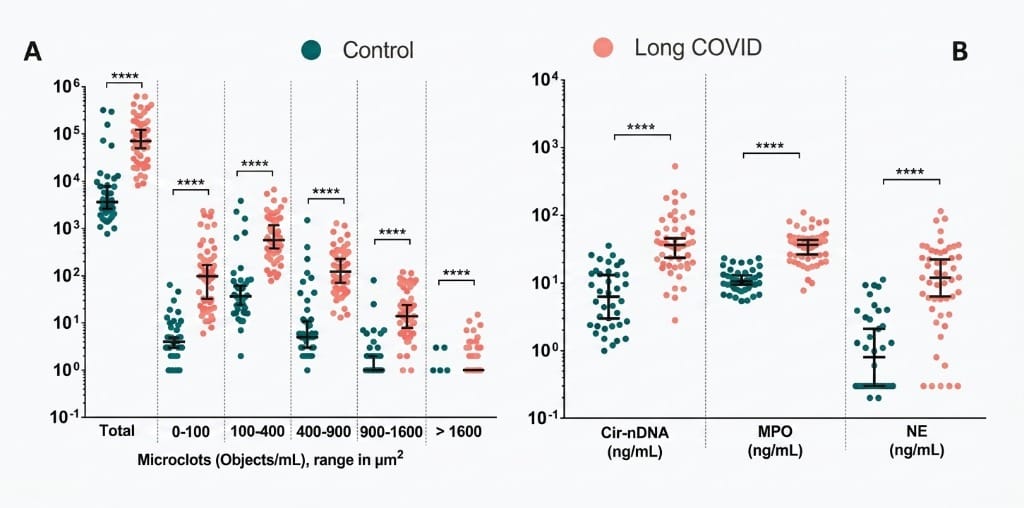
Using fluorescence microscopy with Thioflavin T, Pretorius and colleagues found that plasma from people with Long COVID still contained large anomalous amyloid deposits, while plasma from healthy controls showed far less (Pretorius et al., 2021). Some later cohorts reported that higher microclot counts tended to go with heavier symptom burden, though those were correlations in small groups.
Resistance to breakdown
The same 2021 study found that the microclots in acute COVID-19 and Long COVID samples resisted fibrinolysis and survived a first round of trypsin digestion. Only a second digestion dissolved them. That stubbornness is why D-dimer, which measures breakdown fragments, may not reflect them, as explained in D-dimer vs microclot testing.
Trapped inflammatory proteins
When researchers dissolved the clots and ran proteomics, they found inflammatory molecules packed inside. These included α2-antiplasmin, von Willebrand factor and serum amyloid A (Kruger et al., 2022). Trapping a plasmin inhibitor inside the clot offers one plausible reason the clots don't dissolve on their own.
| Finding | Type of evidence | Source |
|---|---|---|
| More ThT-positive microclots in Long COVID plasma | Small observational cohort | Pretorius et al., 2021 |
| Microclots resist fibrinolysis and trypsin | Lab analysis of patient plasma | Pretorius et al., 2021 |
| α2-antiplasmin, vWF and SAA trapped inside | Proteomics | Kruger et al., 2022 |
| Spike protein can make fibrin harder to break down | In vitro studies | See spike protein amyloid fibrils and fibrinolysis |
| Microclots co-locate with NETs | Observational | See microclots and NETs in Long COVID |
How fibrin amyloid microclots form
Researchers think inflammation, rather than a single trigger, pushes fibrinogen into the amyloid form. Bacterial fragments like lipopolysaccharide, high blood sugar and the SARS-CoV-2 spike protein have all induced amyloid fibrin in lab experiments. The spike work is the reason this topic overlaps with post-vaccination microclots, since the same protein is involved.
There's also a cross-seeding angle. Once one protein misfolds into amyloid, it may template other proteins to do the same, a process covered in spike amyloid cross-seeding.
Clinical next step
Curious what your own sample shows?
Our at-home amyloid fibrin test gives you microscopy data you can take to your clinician.
Start screeningHow could microclots cause Long COVID symptoms?
The microclot hypothesis says that enough of these particles could slow blood flow through capillaries and cut oxygen delivery to tissues. Kell and Pretorius have also suggested that repeated cycles of poor flow and reperfusion could add oxidative damage, which might help explain post-exertional crashes (Kell and Pretorius, 2022).
| Symptom | Proposed mechanism (not proven) |
|---|---|
| Fatigue | Reduced oxygen delivery to muscle |
| Brain fog | Impaired cerebral microcirculation |
| Post-exertional malaise | Ischaemia and reperfusion stress after effort |
| Dysautonomia | Poor perfusion of autonomic nerves and baroreceptors |
| Breathlessness | Capillary blockage in the lungs causing ventilation-perfusion mismatch |
Why don't standard blood tests detect microclots?
Routine coagulation tests measure how fast plasma clots (PT, aPTT) or how much breakdown product is circulating (D-dimer). None of them looks at the shape or structure of clot particles. That's why the research uses fluorescence microscopy instead, a method we explain in the amyloid fibrin test guide. For a side-by-side of every testing route, see how to test for microclots.
The dye side of that method, including what Thioflavin T does and doesn't bind, is covered in the amyloid fibril test guide.
Treatments under study
The evidence here is early and mixed. Kell, Pretorius and clinical collaborators have described several approaches, mostly in case series and reviews rather than controlled trials (Kell et al., 2022).
- Combination anticoagulant and antiplatelet regimens, sometimes called triple therapy, used under specialist supervision because of bleeding risk.
- Therapeutic apheresis, which filters plasma outside the body. Our guide to microclot testing labs and treatment centers covers what to ask before booking.
- Fibrinolytic enzymes such as nattokinase and lumbrokinase. Lab data and its limits are reviewed in nattokinase for microclots.
What are the limitations of microclot research?
Critics raise four main points, and they're fair ones.
- Causation: microclots could drive symptoms, or they could be a downstream sign of inflammation.
- Specificity: they also appear in diabetes and other inflammatory diseases, so they aren't unique to Long COVID.
- Method standardization: sample handling, staining and scoring vary between labs, and there's no agreed reference range.
- Treatment evidence: there are no large randomized controlled trials showing that clearing microclots improves outcomes.
Some haematologists have argued that the wider evidence doesn't yet support clotting as the main driver of Long COVID (Hunt et al., 2024). That debate is healthy, and it's the reason results from any microclot test should be read as observational data.
Where testing fits for patients
If you want to see whether your own sample shows ThT-positive fibrin material, our at-home amyloid test uses the same staining principle as the published studies. You collect a finger-prick dried blood sample at home and receive a Videographic Microscopy Report. It isn't a diagnosis, and a clinician should interpret it alongside your history.
Frequently asked questions
Are fibrinaloid microclots the same as fibrin amyloid microclots?
Yes. Kell and Pretorius coined fibrinaloid as shorthand for fibrin that has taken on an amyloid form, and both terms describe the same particles. You'll also see amyloid microclots or simply microclots in news coverage. In each case the defining feature is a fibrin clot that binds amyloid dyes like Thioflavin T and resists normal breakdown.
Do microclots show up in people without Long COVID?
Yes. The same research groups have reported fibrin amyloid microclots in type 2 diabetes, other inflammatory conditions and, at lower levels, in some healthy controls. That's one reason researchers treat them as a marker of an inflamed clotting system rather than a test specific to Long COVID. Specificity is one of the main open questions in the field.
Has any trial proven that clearing microclots improves Long COVID?
Not yet. Case series and small open-label reports have described anticoagulant combinations and apheresis, but no large randomized controlled trial has shown that removing microclots improves symptoms. Treatments that affect clotting also carry bleeding risk, so any decision belongs with a clinician who can weigh benefit against harm for you.
Who discovered fibrin amyloid microclots?
Resia Pretorius at Stellenbosch University and Douglas Kell at the University of Liverpool described amyloid forms of fibrin in inflammatory diseases years before COVID-19. From 2021 their groups and collaborators applied the same staining and microscopy methods to acute COVID-19 and Long COVID plasma, which brought the work to wider attention.
Sources
- Persistent clotting protein pathology in Long COVID/Post-Acute Sequelae of COVID-19 (PASC) is accompanied by increased levels of antiplasmin. Cardiovascular Diabetology, 2021
- A central role for amyloid fibrin microclots in long COVID/PASC: origins and therapeutic implications. Biochemical Journal, 2022
- The potential role of ischaemia-reperfusion injury in chronic, relapsing diseases such as rheumatoid arthritis, Long COVID, and ME/CFS: evidence, mechanisms, and therapeutic implications. Biochemical Journal, 2022
- Proteomics of fibrin amyloid microclots in long COVID/post-acute sequelae of COVID-19 (PASC) shows many entrapped pro-inflammatory molecules that may also contribute to a failed fibrinolytic system. Cardiovascular Diabetology, 2022
- Challenging the current hypothesis that thrombosis is responsible for the post-COVID-19 condition. Research and Practice in Thrombosis and Haemostasis, 2024
At-Home Amyloid Test
Curious what your own sample shows?
Our at-home amyloid fibrin test gives you microscopy data you can take to your clinician.
Next steps
- What Are Microclots? A Plain-Language Guide to Amyloid MicroclotsWhat microclots are, how fibrin folds into amyloid microclots that resist breakdown, the symptoms researchers link to them, and how they're tested.
- How to Test for Microclots: Methods, Options and What Results MeanHow to test for microclots: the methods researchers use, why D-dimer can't detect them, where to get a microclot test and how to read the result.
- Amyloid Fibrin Test: How Fibrin Amyloid Microclots Are DetectedWhat an amyloid fibrin test is, how Thioflavin T microscopy spots fibrin amyloid microclots, how it differs from D-dimer, and what it can't tell you.

Tim Ottowitz
CTO, Amyloid Test
Tim Ottowitz leads product and technical systems at Amyloid Test, translating research into clear patient-facing screening workflows and educational resources.
Keep reading
D-Dimer vs Microclot Test: Why a Normal D-Dimer Can Miss Microclots
D-dimer vs microclot test compared: what each measures, why D-dimer can read normal in Long COVID, and how Thioflavin T microscopy finds fibrin amyloid.

Spike Protein Amyloid Fibrils: How Spike685 Makes Clots Resist Lysis
How spike protein amyloid fibrils change fibrin clots: what the 2025 Linköping study found for Spike601 and Spike685, and what it cannot yet tell us.
Neutrophil Extracellular Traps in Long COVID: The Microclot-NET Study
A 2025 study found neutrophil extracellular traps tangled into microclots in Long COVID. What the paper measured, what it found, and what it can't prove.