Types of Amyloid Tests: Blood Tests, PET, CSF, Biopsy and Microclots
Short answer
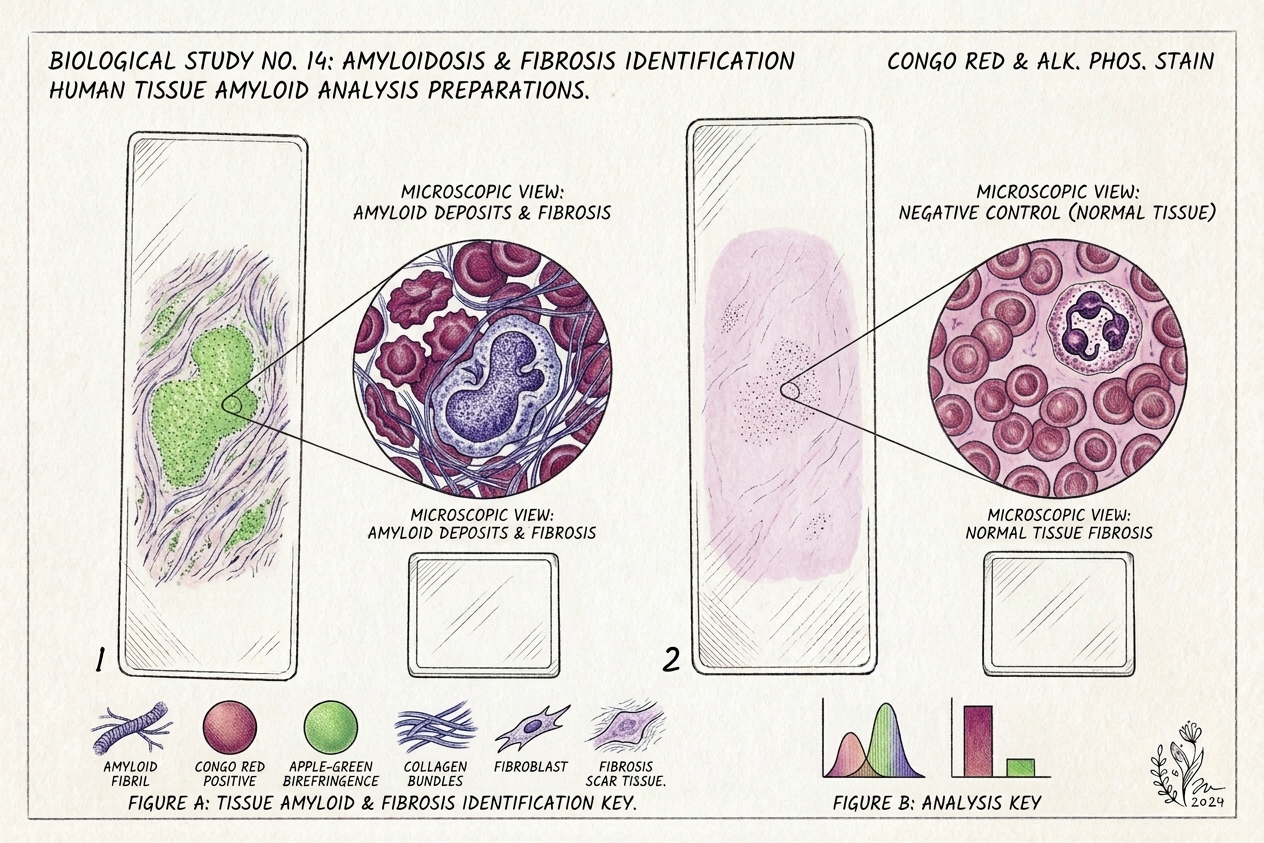
"Amyloid test" covers several unrelated tests. Alzheimer's blood tests (p-tau217, Aβ42/40), amyloid PET scans and spinal fluid tests look for brain amyloid plaques. Systemic amyloidosis is diagnosed with a tissue biopsy stained with Congo red, then protein typing and blood tests. Fibrin amyloid microclot microscopy looks for misfolded clotting protein in blood and is still a research-stage method.
Key takeaways
- 1Amyloid is a protein shape, not one disease, so each amyloid test answers a different medical question.
- 2In May 2025 the FDA cleared the first blood test to aid in diagnosing Alzheimer's disease, for adults 55 and older with symptoms in specialized care.
- 3Amyloid PET and spinal fluid tests remain the reference methods that Alzheimer's blood tests are measured against.
- 4Systemic amyloidosis needs tissue: a biopsy stained with Congo red, then typing of the amyloid protein, often by mass spectrometry.
- 5Fibrin amyloid microclot tests, including our at-home kit, belong to a separate, research-stage category and don't test for Alzheimer's or amyloidosis.
Search for "amyloid test" and you'll find brain scans, spinal taps, biopsies and blood tests side by side, as if they were interchangeable. They aren't. This guide sorts the main types of amyloid tests by the question each one answers, who it's for and how it's done, so you can work out which one actually fits your situation.
Why are there so many types of amyloid tests?
Amyloid is a protein shape, not a single protein. Many different proteins can misfold into stacked, beta-sheet-rich fibrils, and each one is linked to a different condition.
Amyloid-beta builds plaques in the brain in Alzheimer's disease. Antibody light chains or transthyretin deposit in the heart, kidneys and nerves in systemic amyloidosis. Fibrin, the clotting protein, can form amyloid-like microclots in blood in research on Long COVID and inflammatory disease.
So an "amyloid test" only makes sense once you know which protein and which part of the body you're asking about. Mixing them up has real costs: a normal Alzheimer's blood test says nothing about microclots, and a microclot result says nothing about brain plaques or amyloidosis. Our pillar on the amyloid fibril test explains the lab methods that detect the amyloid shape itself. This guide is about the tests patients actually encounter.
The main types of amyloid tests at a glance
| Test type | What it looks for | Sample or method | Who it's for | Clinical status | Learn more |
|---|---|---|---|---|---|
| Alzheimer's blood tests (p-tau217, Aβ42/40) | Signs that brain amyloid plaques are likely | Blood draw | Adults with cognitive symptoms in specialized care | First test FDA-cleared in 2025; quality varies by brand | Amyloid-beta and the immune system |
| Amyloid PET scan | Amyloid-beta plaques in the brain | Radioactive tracer and PET imaging | People being assessed for Alzheimer's or for anti-amyloid treatment | Established, with appropriate use criteria | Spike amyloid and Alzheimer's proteins |
| Spinal fluid (CSF) tests | Aβ42/40, p-tau and related markers | Lumbar puncture | People in memory specialist workups | Established; FDA-authorized assays exist | Prion-like behavior of spike and tau |
| Systemic amyloidosis workup | Amyloid deposits in organs and the protein type | Biopsy with Congo red, mass spectrometry typing, blood and urine tests, cardiac imaging | People with suspected AL, ATTR or other amyloidosis | Standard clinical care | Amyloid fibril test methods |
| Fibrin amyloid microclot microscopy | Fibrinolysis-resistant fibrin amyloid microclots | Thioflavin T fluorescence microscopy of a blood sample | People with persistent post-viral or post-vaccination symptoms; researchers | Research-stage; no agreed cutoff | Amyloid fibrin test |
We haven't listed prices for the clinical tests. They vary widely by country, insurer and setting, and we couldn't find reliable published ranges to quote.
What is the Alzheimer's amyloid blood test?
This is the test most people mean when they search "amyloid blood test." It doesn't detect plaques directly. It measures proteins in plasma, mainly p-tau217 and the ratio of amyloid-beta 42 to 40, that track with plaque buildup in the brain.
In May 2025, the FDA cleared the first blood test to aid in diagnosing Alzheimer's disease, the Lumipulse G pTau217/β-Amyloid 1-42 Plasma Ratio. It's intended for adults aged 55 and older with signs and symptoms of the disease, in specialized care. In the FDA's review of 499 plasma samples, 91.7% of people with a positive result had amyloid plaques on PET or spinal fluid testing, and 97.3% of those with a negative result didn't. Fewer than 20% got an indeterminate result.
The science behind it built over several years. A 2020 JAMA study found plasma p-tau217 distinguished Alzheimer's dementia from other neurodegenerative diseases with an area under the curve of 0.96 in one cohort, performing about as well as spinal fluid and tau PET measures.
What the guideline says about blood tests
In 2025 the Alzheimer's Association published its first clinical practice guideline on blood-based biomarkers. It says tests with at least 90% sensitivity and 75% specificity can be used for triage, and tests with at least 90% sensitivity and 90% specificity can substitute for PET or spinal fluid testing in people with cognitive impairment seen in specialized memory care.
The panel also warned that accuracy varies a lot, that many commercial tests don't meet those thresholds, and that blood tests don't replace a full clinical evaluation. In other words, the brand and the setting both matter.
What does an amyloid PET scan show?
An amyloid PET scan uses a radioactive tracer that binds amyloid-beta plaques, then images where it collects in the brain. It's been the main reference for brain amyloid for years. The FDA notes that PET can show plaques often years before symptoms, but also that it's costly, time-consuming and involves radiation exposure.
In 2025 the Alzheimer's Association and the Society of Nuclear Medicine and Molecular Imaging updated their appropriate use criteria for amyloid and tau PET, rating 17 clinical scenarios where a scan may be considered. PET is mainly used in memory clinics, research and decisions about anti-amyloid therapies.
What do spinal fluid (CSF) amyloid tests measure?
Cerebrospinal fluid tests measure amyloid-beta and tau markers in fluid collected by lumbar puncture (a spinal tap). The FDA notes that authorized CSF tests are already in use, and that the newer blood test avoids the invasive procedure.
According to the National Institute on Aging, biomarkers like these help, but no single test can diagnose Alzheimer's or a related dementia. They're one part of a full assessment that includes history, cognitive testing and often imaging.
If you're curious about how spike protein research connects to brain amyloid, our article on spike protein amyloids cross-seeding Alzheimer's and prion proteins covers the lab studies. None of those findings are measured by the Alzheimer's tests above.
Comparing the three Alzheimer's amyloid tests
Blood tests, PET and spinal fluid testing all aim at the same target, amyloid-beta pathology in the brain, but they get there differently.
| Blood test (p-tau217, Aβ42/40) | Amyloid PET | CSF test | |
|---|---|---|---|
| How it's done | Standard blood draw | Tracer injection and brain scan | Lumbar puncture |
| What it reflects | Plasma proteins that track with plaques | Plaque location and amount in the brain | Amyloid and tau markers in spinal fluid |
| Main drawbacks | Accuracy varies by brand; some results indeterminate | Cost, time and radiation exposure | Invasive procedure |
| Typical setting | Specialized memory care | Memory clinics, research, treatment decisions | Memory clinics, research |
The FDA and the Alzheimer's Association both frame blood tests as part of a specialist workup in people who already have symptoms, not as a stand-alone screen.
What does a positive Alzheimer's amyloid result mean?
A positive biomarker result means amyloid pathology is likely present. It doesn't, on its own, mean someone has dementia, how fast things will change, or that amyloid is the cause of every symptom. The NIA is explicit that biomarkers are only part of a complete assessment.
False results happen too. The FDA lists false positives and false negatives as the main risks of the Lumipulse blood test: a false positive could lead to an inappropriate diagnosis and unnecessary treatment, and a false negative could delay the right care. That's why results are interpreted alongside cognitive testing and clinical history.
How is systemic amyloidosis diagnosed?
Systemic amyloidosis is a different disease family. Misfolded proteins, most often antibody light chains (AL) or transthyretin (ATTR), deposit in organs such as the heart, kidneys, liver and nerves. A 2016 Lancet seminar describes how the workup has changed, and it's built in layers:
- Tissue biopsy with Congo red. A sample of fat, bone marrow or the affected organ is stained with Congo red and viewed under polarized light. A 2019 review cautions that Congo red alone isn't enough for diagnosis, which is why the next step matters.
- Typing the protein. Treatment depends on which protein formed the amyloid. A 2009 Blood study showed that laser microdissection plus mass spectrometry identified the amyloid type with 100% specificity and sensitivity in a 50-case training set and 98% in a 41-case validation set. This method is now widely available.
- Blood and urine tests. These look for a monoclonal protein, including serum free light chains, which points toward AL amyloidosis.
- Cardiac imaging. In a multicenter Circulation study of 1,217 patients, bone scintigraphy was more than 99% sensitive and 86% specific for cardiac ATTR amyloid. When strong tracer uptake was combined with no monoclonal protein in blood or urine, specificity and positive predictive value reached 100%, allowing diagnosis without a heart biopsy in many patients.
This workup is run by hematologists, cardiologists and nephrologists. It's not something a home kit or a brain scan can replace.
What is a fibrin amyloid microclot test?
The last category is the newest and the least established. Researchers led by Resia Pretorius and Douglas Kell found that fibrin can clot into an anomalous amyloid form that resists breakdown. In their 2022 Biochemical Journal review, they describe measuring these microclots in platelet-poor plasma with Thioflavin T and a fluorescence microscope.
Our full pillar on the amyloid fibrin test covers how it works and what results show. The background research is summarized in fibrin amyloid microclots research, and the patient-facing story is in amyloid microclots and Long COVID.
The method is still evolving. In a 2023 Heliyon study, the same group said its earlier microscopy lacked objectivity and throughput, and showed that imaging flow cytometry could count and size microclots more objectively. They suggested conventional flow cytometry, already common in pathology labs, might eventually make the test easier to run.
Three caveats matter here:
- It's research-stage. There's no agreed cutoff or regulatory approval as a diagnostic test.
- It's contested. A 2024 critical appraisal by Hunt and colleagues argued the microclot hypothesis isn't supported by the evidence and that antithrombotic treatment or apheresis outside trials isn't justified. The original researchers disagree.
- It's not D-dimer. D-dimer measures fragments from clots being broken down, which is a different question. See D-dimer vs microclot test for the comparison.
Clinical next step
Looking specifically for fibrin amyloid microclots?
Our at-home amyloid fibrin test covers that one category, with a video microscopy report you can share with your doctor.
Start screeningWhere our at-home kit fits
Our at-home amyloid test belongs only to this last category. It's an amyloid fibrin test: you collect a finger-prick dried blood sample at home and mail it to our partner laboratory in Mexico City. The lab stains it with Thioflavin T, the same staining principle used in the published Pretorius and Kell microclot research, and records 6K 12-bit RAW video microscopy at 20× magnification under UV illumination. Footage is reviewed with AI-assisted fibril detection plus trained human oversight.
You receive a Videographic Microscopy Report in a secure client portal, typically within 1 day of the lab receiving your sample and 5–7 business days from kit delivery including shipping. It costs $160 USD (3,200 MXN) and includes access to a directory of doctors experienced with amyloid-related care.
To be completely clear about what it isn't:
- It's not an Alzheimer's test. It doesn't measure plasma Aβ42/40 or p-tau, it isn't PET or CSF testing, and it can't detect brain amyloid plaques.
- It's not a test for systemic amyloidosis (AL or ATTR).
- It doesn't measure spike protein, D-dimer, fibrinogen or any standard coagulation value. If spike protein is your question, see spike protein persistence testing.
- It's not a diagnostic test or a medical device. It gives laboratory observational data for informational and research purposes, and a qualified healthcare provider should interpret it.
Which amyloid test should you consider?
Work backward from the question:
- Memory or thinking changes? Ask your doctor about a memory clinic referral. Blood tests, PET or spinal fluid testing may follow.
- Unexplained heart thickening, kidney protein loss, numbness or a known monoclonal protein? Ask about an amyloidosis workup with a specialist.
- Persistent fatigue, brain fog or breathlessness after COVID-19 or vaccination, with normal routine labs? That's the setting where fibrin amyloid microclot testing is being studied. Read the amyloid fibrin test guide first, and check our directory of microclot testing labs and treatment centers or our doctor directory to find clinicians familiar with the research.
Questions to bring to your appointment
Whichever path fits, these questions help you get more out of the conversation:
- Which protein and which organ is this test looking at?
- Is the test cleared or validated for someone with my symptoms and age?
- What happens next if the result is positive, negative or unclear?
- Will the result change what we do, or is it mainly for information?
- Who will interpret it, and will I get the full report?
Asking these before testing saves a lot of confusion afterward, especially with amyloid, where the same word covers such different tests.
If you want to understand the lab chemistry that ties all of these together, our amyloid fibril test guide compares Thioflavin T, Congo red, electron microscopy and seeding assays.
Frequently asked questions
Is there a blood test for amyloid?
There are several, and they measure different things. Alzheimer's blood tests measure p-tau217 and amyloid-beta 42/40 in plasma to estimate whether brain amyloid plaques are likely. Blood and urine tests for monoclonal proteins support an amyloidosis workup, but tissue confirms it. Fibrin amyloid microclot tests stain a blood sample with Thioflavin T and look for misfolded clotting protein. Check which question a test answers before ordering it.
How accurate is the Alzheimer's amyloid blood test?
It depends on the test. In the FDA's review of the Lumipulse plasma ratio test, 91.7% of people with a positive result had amyloid on PET or spinal fluid testing, and 97.3% with a negative result didn't. Under 20% got an indeterminate result. The Alzheimer's Association warns that many commercial blood tests don't meet its accuracy thresholds.
Can I get an Alzheimer's blood test without symptoms?
Current FDA clearance and Alzheimer's Association guidance focus on people who already have cognitive symptoms and are being evaluated in specialized care. Results in people without symptoms are harder to interpret, and a positive result doesn't mean someone will develop dementia. If you're worried about memory, start with your doctor, who can decide whether a referral and biomarker testing make sense.
Does an amyloid PET scan detect amyloidosis?
Not usually. Amyloid PET tracers are designed to bind amyloid-beta plaques in the brain, and appropriate use criteria cover Alzheimer's evaluation. Systemic amyloidosis, such as AL or ATTR, involves different proteins in organs like the heart and kidneys. It's assessed with tissue biopsy, protein typing, blood and urine tests, and cardiac imaging such as bone scintigraphy or cardiac MRI.
Is the at-home amyloid test the same as an Alzheimer's test?
No. Our at-home kit is an amyloid fibrin test. It stains a dried blood sample with Thioflavin T and records video microscopy of fibrin amyloid structures. It doesn't measure plasma amyloid-beta or p-tau, it isn't a PET or spinal fluid test, and it can't detect brain plaques. It isn't a diagnostic test, so results go to a healthcare provider for interpretation.
Which amyloid test should I ask my doctor about?
Start from your symptoms. Memory and thinking problems point toward Alzheimer's biomarker testing through a memory specialist. Unexplained heart thickening, kidney protein loss or nerve symptoms can point toward an amyloidosis workup. Persistent symptoms after COVID-19 with normal routine labs is the setting where fibrin amyloid microclot testing is being researched. Your doctor can help choose and interpret.
Sources
- FDA Clears First Blood Test Used in Diagnosing Alzheimer's Disease. U.S. Food and Drug Administration, 2025
- Alzheimer's Association Clinical Practice Guideline on the use of blood-based biomarkers in the diagnostic workup of suspected Alzheimer's disease within specialized care settings. Alzheimer's & Dementia, 2025
- Discriminative Accuracy of Plasma Phospho-tau217 for Alzheimer Disease vs Other Neurodegenerative Disorders. JAMA, 2020
- Updated appropriate use criteria for amyloid and tau PET. Alzheimer's & Dementia, 2025
- How Biomarkers Help Diagnose Dementia. National Institute on Aging
- Systemic amyloidosis. The Lancet, 2016
- Classification of amyloidosis by laser microdissection and mass spectrometry-based proteomic analysis in clinical biopsy specimens. Blood, 2009
- Nonbiopsy Diagnosis of Cardiac Transthyretin Amyloidosis. Circulation, 2016
- Congo Red and amyloids: history and relationship. Bioscience Reports, 2019
- A central role for amyloid fibrin microclots in long COVID/PASC: origins and therapeutic implications. Biochemical Journal, 2022
- Accelerating discovery: A novel flow cytometric method for detecting fibrin(ogen) amyloid microclots using long COVID as a model. Heliyon, 2023
- Challenging the current hypothesis that thrombosis is responsible for the post-COVID-19 condition. Research and Practice in Thrombosis and Haemostasis, 2024
At-Home Amyloid Test
Looking specifically for fibrin amyloid microclots?
Our at-home amyloid fibrin test covers that one category, with a video microscopy report you can share with your doctor.
Next steps
- Amyloid Fibrin Test: How Fibrin Amyloid Microclots Are DetectedWhat an amyloid fibrin test is, how Thioflavin T microscopy spots fibrin amyloid microclots, how it differs from D-dimer, and what it can't tell you.
- Amyloid Fibril Test: Methods Used to Detect Amyloid FibrilsHow an amyloid fibril test works: Thioflavin T, Congo red, electron microscopy, X-ray diffraction and seeding assays compared, with which are clinical.
- Spike Protein and Alzheimer's: The Spike Amyloid Cross-Seeding StudySpike protein amyloid sped up misfolding of Alzheimer's amyloid-beta and prion protein in a lab study. What it shows about the brain, and what it doesn't.

Tim Ottowitz
Founder & Research Lead
Tim Ottowitz founded Amyloid Test and writes its Science Hub, turning fibrin amyloid and spike protein research into plain-language guides that stay close to the published evidence.
Keep reading
D-Dimer vs Microclot Test: Why a Normal D-Dimer Can Miss Microclots
D-dimer vs microclot test compared: what each measures, why D-dimer can read normal in Long COVID, and how Thioflavin T microscopy finds fibrin amyloid.
Neutrophil Elastase and Spike Protein: How Amyloid Forms
Neutrophil elastase cuts SARS-CoV-2 spike into amyloid-forming fragments. A plain-English walkthrough of the 2022 JACS study and what it does not show.

Spike Protein Amyloid Fibrils: How Spike685 Makes Clots Resist Lysis
How spike protein amyloid fibrils change fibrin clots: what the 2025 Linköping study found for Spike601 and Spike685, and what it cannot yet tell us.