Laboratory Screening
The At-Home Amyloid Test
See whether amyloid fibrin microclots are visible in your blood. You take a finger-prick sample at home, and our lab images it with Thioflavin T fluorescence microscopy.
- $160 total, no hidden fees
- Report within 1 day of lab receipt
- Full refund if you cancel before shipment
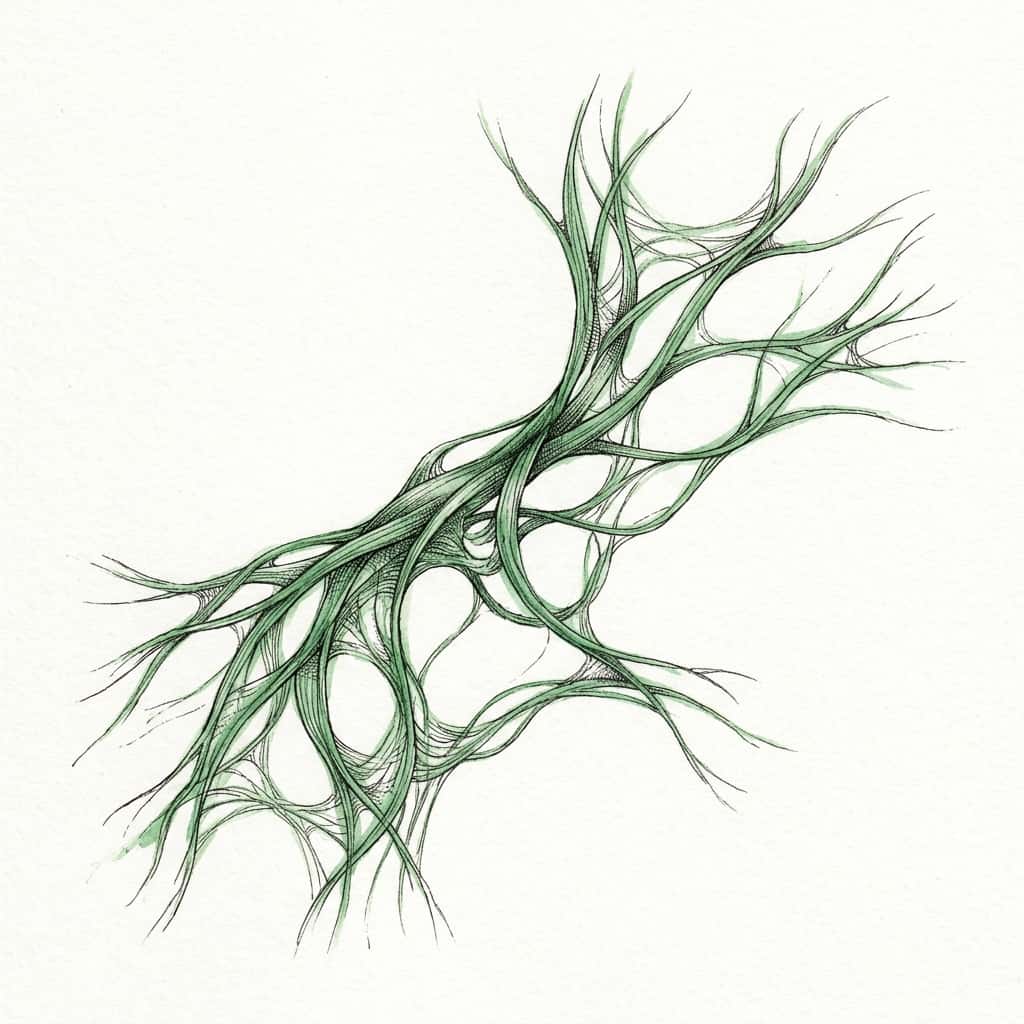
Illustration: amyloid fibrin under Thioflavin T
Why we started testing
Billions were exposed to spike protein. Almost no one is being tested.
- 01COVID-19 exposed most people on earth to spike protein. mRNA vaccines tell your cells to make the same spike.
- 02Clotting is how your body repairs damaged vessels, and it has an off switch: once you heal, enzymes dissolve the clot. In lab studies, spike protein jams that off switch. Clots that should dissolve stay.
- 03Where researchers have looked, they've found these clots: in people with Long COVID and in vaccinated people.
Exposure on this scale, and almost nobody is testing for it. That makes no sense. So we started testing.
Grobbelaar et al., 2021Pretorius et al., 2021Vaccine research summary
A global medical blind spot
Worldwide, only a handful of labs are looking for amyloid fibrin microclots
If you go to a major medical center, a university hospital or a local ER with debilitating fatigue, vascular pain and cognitive crashes, you assume they're testing for everything.
They aren't. But you don't have to wait for medicine to catch up. Our lab in Mexico City stains your dried blood sample with Thioflavin T and records it in 6K video, so you can see your own sample.
Direct-to-consumer · 6K video report · 1-day lab turnaround
Why don't standard labs find it?
- The diagnostic gap. Routine tests like D-dimer measure fragments from clot breakdown. Amyloid microclots resist breakdown, and standard assays aren't designed to detect misfolded fibrin.
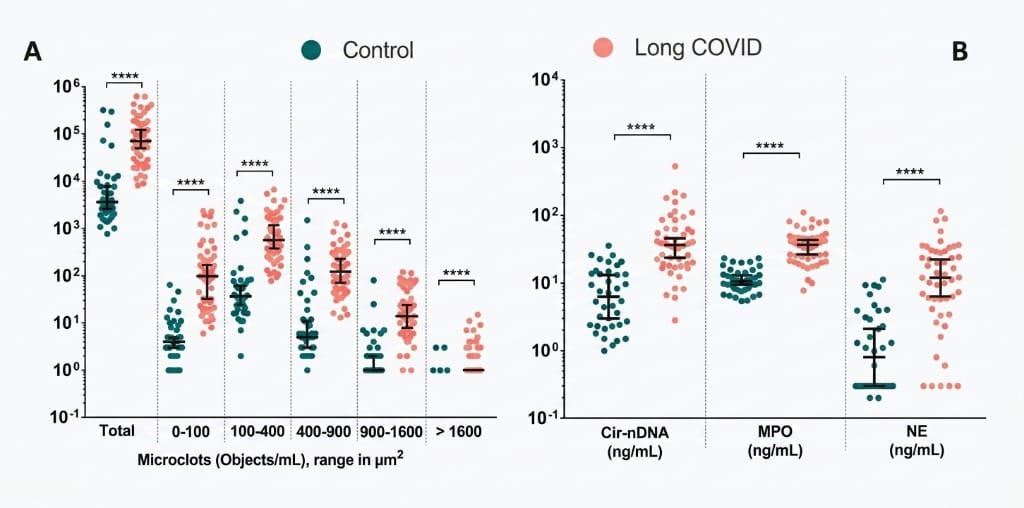
- What post-2020 research found. Researchers found microclots and raised antiplasmin, a brake on clot breakdown, in people with Long COVID. In lab tests, spike protein made fibrin clots resist breakdown.Pretorius et al., 2021Grobbelaar et al., 2021
- Nothing to order. There's no standard hospital test and no agreed reference range yet, so most doctors can't order it even if they want to.
The Mechanism
What are amyloid fibrin microclots?
Amyloid fibrin microclots are small clots in which fibrin, the protein that normally forms soft, temporary clots, has misfolded into a dense amyloid structure. They resist the enzymes that usually dissolve clots, and researchers have described them in people with Long COVID. Under Thioflavin T dye they fluoresce, which is how our lab finds them.
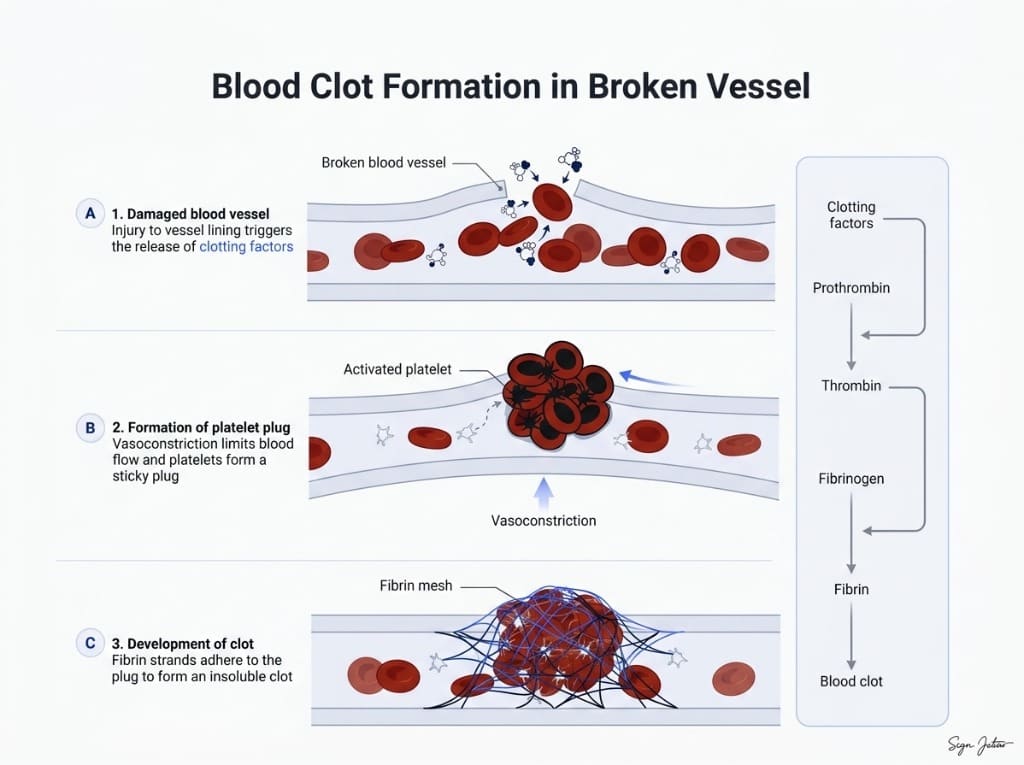
Fibrin is the protein your body uses to patch damaged blood vessels. When a vessel is damaged, a rapid clotting cascade turns soluble fibrinogen into long, sticky threads of insoluble fibrin.
These interwoven fibrin strands act as a structural mesh (shown in Stage C), catching red blood cells to form a standard clot. Once the injury heals, your body deploys enzymes to dissolve this temporary mesh, a process called fibrinolysis.
The Pathology of Amyloid Microclots
Under chronic vascular stress or strong inflammation, this natural fibrin cascade can go wrong. The fibrin misfolds into an "AMYLOID" state, a dense beta-sheet structure.
That turns the temporary mesh into a persistent, rigid microclot that resists your body's natural breakdown process.
A cycle that feeds itself
Why the clots don't clear
- 1Damage
Inflammation irritates the vessel wall.
- 2Repair
Your blood forms a fibrin clot to patch it. Once you heal, enzymes dissolve it.
- 3Jammed off switch
In lab studies, spike protein makes fibrin resist those enzymes. The clot stays.
- 4More inflammation
Stuck clots trap inflammatory molecules and may slow blood flow in small vessels, inflaming the wall again.
- Back to step 1. Each turn makes the next one harder to stop.
Grobbelaar et al., 2021Westman et al., 2025Kruger et al., 2022
Because these misfolded microclots are invisible to standard hospital coagulation markers...
...our lab looks for them directly, with Thioflavin T staining.
Diagnostic Comparison
Is this the same as an Alzheimer's or cardiac amyloid test?
No. Alzheimer's amyloid tests look for beta-amyloid in the brain, spinal fluid or blood plasma, and cardiac tests look for amyloid deposits in the heart. This amyloid microclot test looks for misfolded fibrin in a dried blood sample, using Thioflavin T fluorescence microscopy.
Our Laboratory Service
$160 — ACCESSIBLE SCREENING
Methodology
Thioflavin T (ThT) fluorescence microscopy. ThT binds specifically to beta-sheet-rich structures, causing amyloid-like fibrin deposits to emit green fluorescence under UV light.
Clinical Focus
Circulating structural protein aggregates forming microclots. Aligned with emerging research into post-viral coagulation patterns.
Sample Type
Traditional Diagnostics
$750–$5,000+ — SPECIALIZED
Primary Methodology
Liquid chromatography-tandem mass spectrometry or PET Imaging with radioactive tracers.
Diagnostic Pathway
Measures soluble Beta-amyloid peptides or brain plaques. Specifically designed for Alzheimer's neurological assessment.
Sample Type
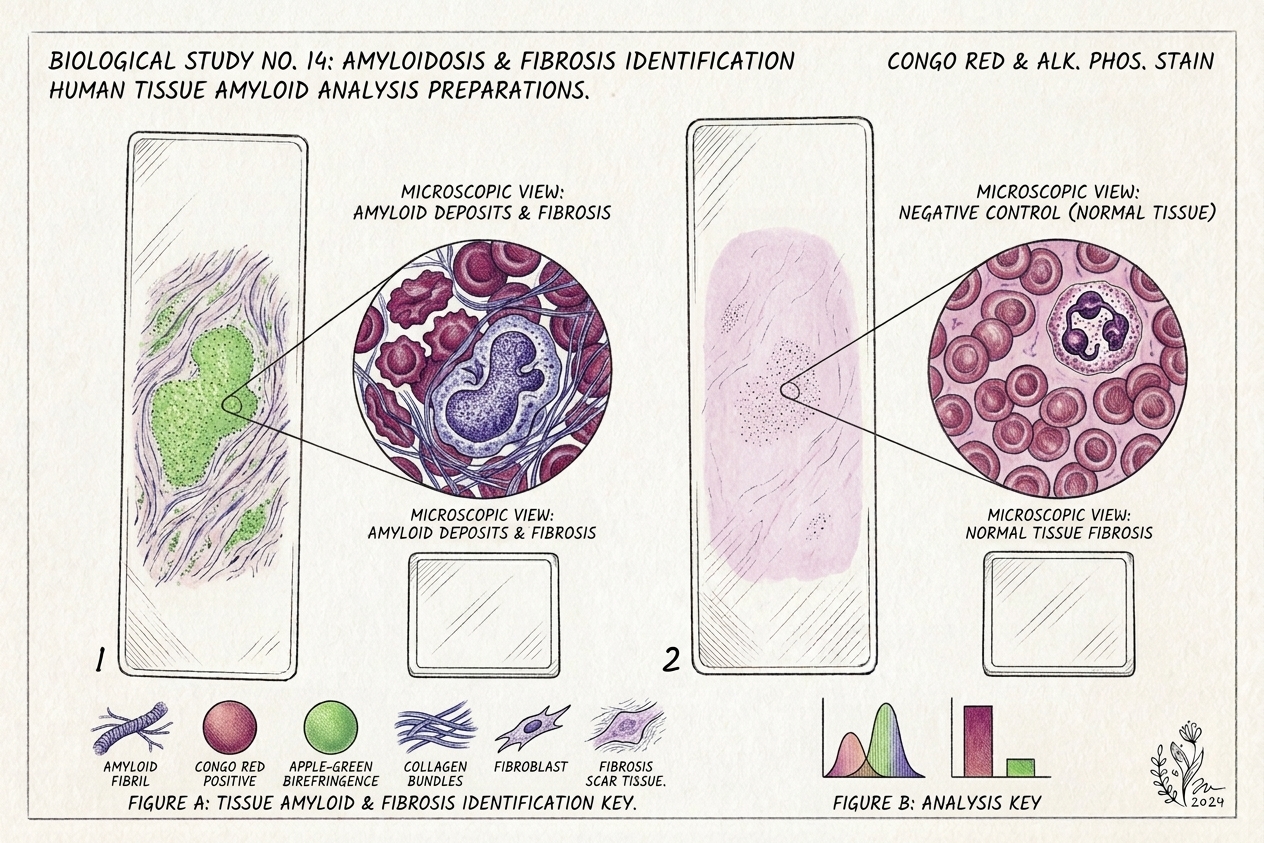
Biological Study No. 14 — Amyloid Deposits & Fibrosis vs. Normal Tissue Control · Congo Red & Alk. Phos. Stain
The Bottom Line
These are fundamentally different assays answering different clinical questions:
Screens for structural fibrin aggregation in blood
—post-viral coagulation patterns and microclot signals.
Measures soluble peptides or brain plaques
—specifically Alzheimer's neurological biomarkers.
They answer different questions. If your concern is Alzheimer's, you need the neurological tests; this test shows fibrin microclots in your blood.
Order your amyloid microclot test kit
Commission a microscopy study of your dried blood sample. Everything you need to collect and return your sample is delivered directly to your door.
No subscription • Cancel anytime before shipment for a full refund
Operational Pipeline
How the at-home amyloid microclot test works
Request a Kit
Select your country and complete checkout. Kits typically ship within one week of order processing.
Clinical Context
Microclots and Long COVID: what the research shows
In a healthy system, fibrin helps your body create a temporary repair mesh when injury occurs. Once the danger passes, that mesh is usually broken down and cleared away.
Some Long COVID research has reported abnormal fibrin structures with amyloid-like properties in certain patients. These structures may be unusually sticky, unusually persistent, and harder for the body's normal cleanup systems to dissolve.
That does not settle the entire question, and it does not explain every case. But it is a serious enough signal that some people want a way to look for it directly, especially when standard coagulation panels have not answered what they are living through.
Treatment Pathways
After a positive result, what now?
A positive result means you can see the microclots: Thioflavin T makes amyloid fibrin glow under the 20× microscope, and your video recording shows each one. It's observational lab data, not a diagnosis, and a concrete starting point for the approaches below.
Double Filtration Plasmapheresis (DFPP)
A blood purification therapy using Japanese Asahi filters to physically remove amyloid microclots, spike protein, and circulating inflammatory complexes from plasma. The McCairn Protocol's core intervention.
Physically removes what enzymes can't dissolve. In some people with very high spike and amyloid levels, microclots return after treatment.
Stem Cell Growth Factor (SGF)
Intravenous infusions of stem cell growth factors following DFPP to promote endothelial repair, restore vascular function, and support tissue regeneration after microclot clearance.
Part 2 of the McCairn Protocol
The McCairn Protocol
Developed by Dr. Kevin McCairn. DFPP + SGF combination therapy designed specifically for post-viral and post-vaccination microclot pathology. Our DFPP program in Mexico is in development and not yet bookable.
Low-Frequency Ultrasound (150 kHz)
Low-intensity ultrasound at 150 kHz broke up amyloid microclots in lab-on-chip studies, shrinking them by over 60%, more than clot-dissolving enzymes managed alone. Still a research approach, not yet a standard treatment.
Key Research Citations
- • Kell DB, Laubscher GJ, Pretorius E. A central role for amyloid fibrin microclots in long COVID/PASC. Biochemical Journal. 2022;479:537-559.
- • Thierry AR, et al. Circulating Microclots Are Structurally Associated With Neutrophil Extracellular Traps. Journal of Medical Virology. 2025;97:e70613.
- • Grixti JM, et al. Automated microscopic measurement of fibrinaloid microclots and their degradation by nattokinase. bioRxiv. 2024.
Analytical Framework
How the lab detects microclots: Thioflavin T fluorescence microscopy
Sample Preparation
Your dried blood sample is prepared with Thioflavin T staining, a fluorescent dye that binds specifically to amyloid fibrils.
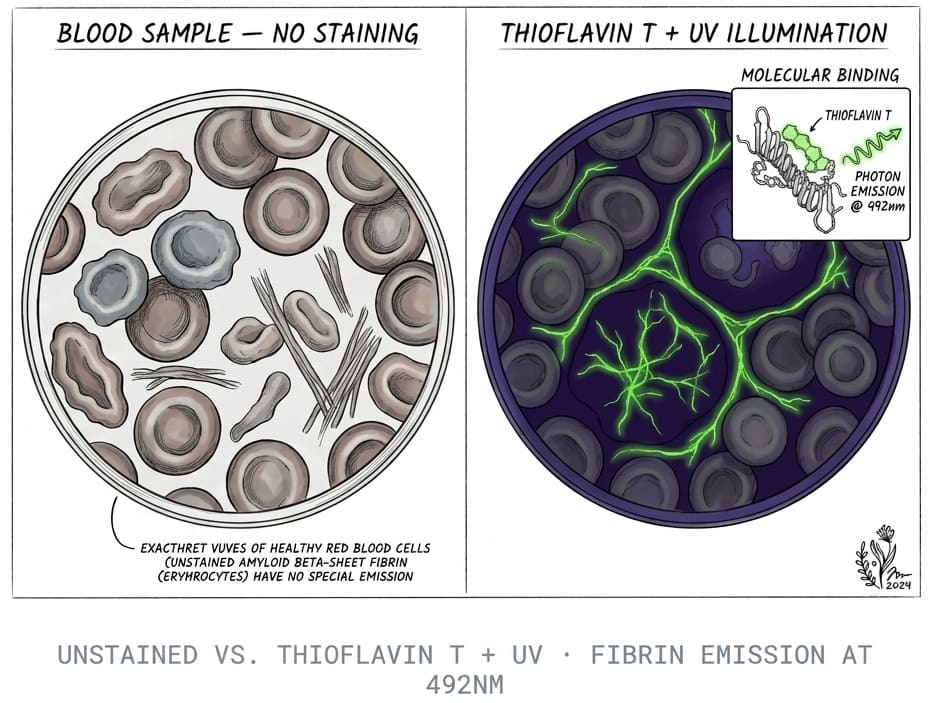
Unstained vs. Thioflavin T + UV · Fibrin Emission at 492nm
Scientific Foundation
Our lab uses Thioflavin T fluorescence microscopy, the same staining principle Pretorius, Kell and colleagues use to detect fibrin amyloid microclots in Long COVID plasma (Pretorius et al., 2021).
Verification
How results are verified: AI analysis plus scientist review
Like code review in software development, your results pass through two independent reviewers: AI-powered analysis and expert human verification. Together, they catch what either might miss.
Path 1: AI-Powered Analysis
PRECISION AT SCALE
Our proprietary local model analyzes your 6K microscopy footage with classification and segmentation: it outlines each fluorescent structure at pixel level and classifies whether it matches amyloid fibrin.
- 6K video analysis
- Classification and segmentation
- Pixel-level fibril detection
Path 2: Expert Scientist Review
HUMAN VERIFICATION
Trained scientists review the AI findings. They catch edge cases, verify patterns, and add context that AI alone can't.
- Human oversight of AI findings
- Edge case detection and verification
- Contextual pattern interpretation
The Result: Consensus Verification
When AI and scientist agree, you get high-confidence results. When they disagree, we investigate further. No assumptions. Just verification.
Laboratory Method
Reference Methodology & Sample Handling
How our partner laboratory stains, records and handles your sample.
Thioflavin T Staining
Thioflavin T (ThT) binds beta-sheet amyloid structures and fluoresces, exciting at ~440nm and emitting at ~492nm. It's the same staining principle used in the published fibrin amyloid research by Pretorius, Kell and colleagues.
Recorded at 20× Under UV
The lab records 6K 12-bit RAW video at 20× magnification under UV light, so every finding is captured as footage you can watch, not just a written verdict.
Dried Blood Sample
You collect a finger-prick sample at home and it's mailed to the lab as a dried blood sample, so there's no liquid tube or needle draw involved.
Next Steps
Your report and next steps
The treatment page is the next step after results, where clients can review provider options and treatment planning.
1. Receive your report
Your microscopy findings create the baseline and show whether there is enough signal to discuss follow-up care.
2. Review treatment options
The treatment page explains what comes after screening, including provider discovery and the post-kit pathway.
3. Plan next steps
If treatment is appropriate, clients can use the dedicated page to move from report review into provider coordination.
Open the treatment page to see providers and the after-kit path.
Open Treatment PageRelevance
Who this amyloid microclot test is for
Most of the global population has been exposed to SARS-CoV-2 or received COVID-19 vaccines. Amyloid fibrin microclots don't show up on standard blood tests, and research is only starting to measure how common they are. If you want data on your own blood, this test shows you what's there.
This is for you if
You understand this is a new and still-emerging area of research. You want to see whether amyloid fibrin microclots are in your blood and discuss the result with a clinician.
- You're investigating persistent post-viral symptoms: fatigue, brain fog, shortness of breath, circulation issues.
- You were exposed to SARS-CoV-2 or received a COVID-19 vaccine and want to know whether microclots are present, with or without symptoms.
- Standard blood work came back "normal" but you still feel unwell, seeking data your clinician can review.
- You understand the difference between laboratory screening and medical diagnosis.
This is not for you if
This test looks for fibrin microclots in blood, so it won't answer these questions:
- You're looking for Alzheimer's or Parkinson's testing. This measures blood fibrin microclots, not brain amyloid plaques.
- You need a medical diagnosis for dementia or neurological disease.
- You have urgent symptoms: chest pain, stroke signs, acute shortness of breath. This is screening, not emergency care.
- You expect insurance coverage. This is self-pay only ($160 USD / 3,200 MXN).
Investment
Amyloid microclot test price: $160
Made affordable through AI-powered automation
What's Included:
No hidden fees. Cancel anytime before shipment for full refund. Results in 1 day from lab receipt.
Common Questions
Amyloid microclot test FAQ
Ready to Screen
Ready to check your blood for amyloid microclots?
You should be able to decide with a clear head: what this service can show, what it cannot prove, and whether it is worth adding to your workup.
🇩🇪🤝🇲🇽 German-Mexican Collaboration
Why I kept building this
I started this company after watching someone close to me struggle with post-vaccine health complications and seeing how hard it was to get affordable amyloid-related testing. Hospital options were often expensive, narrow, or aimed at a different clinical question.
The deeper issue was not only price. Traditional hospital amyloid testing is usually designed for Alzheimer's-related peptide measurement or brain-plaque assessment. That is important work, but it does not directly answer the question many post-viral patients are asking about circulating fibrin structures in blood.
Using my background in data engineering and AI, I partnered with a physician in Mexico City to build a service around Thioflavin T fluorescence microscopy for dried-blood analysis. The goal was not to overclaim. It was to make one serious line of investigation more accessible, more transparent, and easier to discuss with a clinician.
The result is a lower-cost first-line screening option that asks a different question before many people commit to a far more expensive diagnostic path.