Are Microclots Dangerous? Risks, Symptoms and Red Flags
Short answer
Microclots are not the same as the large clots that cause a stroke or pulmonary embolism, and no study shows that a microclot count predicts an emergency. Research suggests they may reduce blood flow in small vessels. Sudden chest pain, breathlessness, weakness or confusion needs emergency care whatever your microclot status.
Key takeaways
- 1A microclot is small enough to pass through capillaries, so its risk differs from a large clot in a vein or artery.
- 2The main research concern is that a high burden of fibrin amyloid microclots could impair oxygen delivery in small vessels.
- 3That concern is still a hypothesis; studies have not shown that microclots cause stroke, heart attack or death.
- 4No validated microclot count or risk score exists, so a result is observational data, not a diagnosis.
- 5Emergency clot symptoms need immediate care, and self-treating with anticoagulants or enzymes is unsafe.
A microclot is small enough to travel through capillaries, so the word "dangerous" means something different than it does for a clot in a leg vein or lung artery. This guide separates what studies actually show from what they don't, then lists symptoms that need urgent care.
What "dangerous" means for a microclot
A typical deep vein thrombosis or pulmonary embolism involves a clot large enough to block a named vein or artery. A microclot is measured in micrometres. It can pass through vessels that a large clot cannot enter, which is why researchers focus on the smallest vessels rather than on a single blockage.
The concern is burden and location. If many amyloid microclots accumulate in capillary beds, blood flow could become uneven. Tissue might get less oxygen even while a pulse oximeter reads normally. That is a plausible mechanism, not a proven outcome. Our guide to what microclots are covers the biology in more detail.
What the research suggests
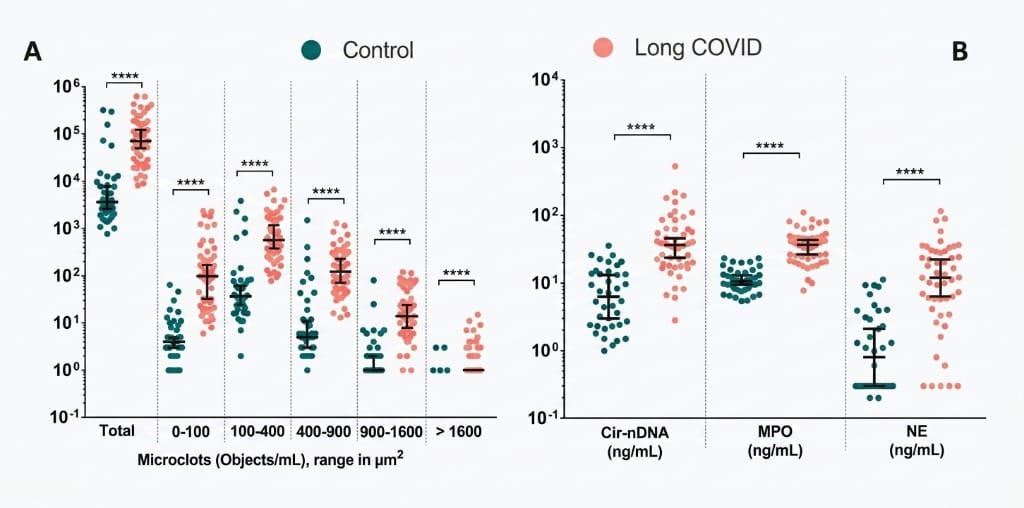
The strongest human evidence comes from small observational studies. A 2022 review proposed that fibrin amyloid microclots resist breakdown and could contribute to the persistent symptoms seen in Long COVID. A 2025 study found more circulating microclots and more neutrophil extracellular trap markers in Long COVID patients than in healthy controls. You can read our breakdown of that microclot and NET study.
None of these studies followed people long enough to show that microclots cause a heart attack, stroke, organ failure or death. They also used different counting methods, which makes a universal risk threshold impossible to set. The evidence supports a research hypothesis about microvascular function, not a clinical risk calculator.
Could microclots cause a stroke or heart attack?
A stroke or heart attack usually involves a larger artery blocked by a clot or atherosclerotic plaque. Microclot research describes particles in plasma and capillary beds, not a clot sitting in a coronary or cerebral artery. Some authors have suggested that microclots could add to inflammation or small-vessel dysfunction, but a direct causal link to stroke or heart attack has not been shown.
That distinction matters for anxiety and for treatment. A normal microclot report does not rule out a large clot, and an abnormal report does not mean a stroke is coming. If you have sudden neurological or cardiac symptoms, get emergency care instead of waiting for a test result.
Symptoms that need urgent care
These are general red flags for large clots and other emergencies. They need immediate assessment even if you have never had a microclot test.
| Symptom | Why it cannot wait |
|---|---|
| Sudden chest pain or pressure | Could be a heart attack or pulmonary embolism |
| Sudden severe breathlessness | Could be a pulmonary embolism or another acute lung problem |
| Coughing blood | Can signal a pulmonary embolism |
| One-sided weakness, facial droop or slurred speech | Stroke until proven otherwise |
| Sudden confusion or fainting | Needs urgent neurological and circulatory assessment |
| Swollen, painful or warm leg | Possible deep vein thrombosis |
| Severe sudden headache | Needs urgent assessment for bleeding or other causes |
For non-emergency symptoms such as fatigue, brain fog or exercise intolerance, our microclot symptoms guide explains what researchers have proposed and why those symptoms have many possible causes.
Who may be at higher risk
People with Long COVID, ongoing inflammation or conditions that affect clotting are the groups most studied. The research is not yet able to say who will develop a high microclot burden or who will have symptoms from it. Age, diabetes, smoking, immobility, surgery, pregnancy and some medications affect ordinary clot risk, but they have not been validated as microclot risk factors.
How doctors assess possible risk
A clinician starts with history, examination and standard tests for conditions that are well understood. Those may include a full blood count, clotting tests, D-dimer when a large clot is suspected, and imaging such as ultrasound or CT when indicated. D-dimer does not detect amyloid microclots, which is why a normal result does not answer the microclot question.
Microclot imaging is observational. A microclots test or a fibrin amyloid test can show whether Thioflavin T-positive material is visible, but there is no agreed reference range. The result should be read alongside symptoms, standard labs and the limits of the published evidence.
What you can do
Do not start anticoagulants, antiplatelets or high-dose enzyme supplements on your own. Some of these can cause bleeding, interact with other medicines or be unsafe before surgery. If you have a report, bring it to a clinician and ask what the findings do and do not change about your care.
If you want to see whether amyloid fibrin material is visible in your sample, our at-home amyloid test uses Thioflavin T fluorescence microscopy. It is not a diagnostic test and does not measure your risk of a large clot. It provides observational data for a conversation with your doctor.
Bottom line
Microclots are worth studying because they may affect small-vessel blood flow, but the evidence does not yet show that they are dangerous in the way a large clot is. The practical response is to take emergency symptoms seriously, avoid unproven self-treatment, and use any microclot result as one piece of information rather than a verdict.
Frequently asked questions
Are microclots life-threatening?
There is no evidence that microclots alone are life-threatening in the way a large pulmonary embolism can be. The concern is chronic or cumulative: if amyloid microclots reduce blood flow in many small vessels, tissues may get less oxygen. That mechanism is still being studied, and no study has linked a specific microclot count to a life-threatening outcome.
Can microclots cause a stroke or heart attack?
A stroke or heart attack usually involves a clot or plaque blocking a larger artery, not the microscopic fibrin particles described in microclot research. Microclots could theoretically contribute to inflammation or small-vessel problems, but a causal link to stroke or heart attack has not been established. Treat sudden neurological or cardiac symptoms as an emergency.
What symptoms should make me call emergency services?
Call emergency services for sudden chest pain or pressure, sudden severe breathlessness, coughing blood, fainting, one-sided weakness, facial droop, slurred speech, sudden confusion, a swollen painful leg, or a severe headache that comes on quickly. These signs can indicate a large clot, stroke or another emergency and should not wait for a microclot test.
Do microclots go away on their own?
Nobody knows for certain. Normal clots are cleared by fibrinolysis, but the research describes amyloid microclots as resistant to plasmin, the main clot-dissolving enzyme. Some people may clear them over time and others may not. There are no long-term studies tracking the same people without treatment, so anyone who claims a fixed timeline is guessing.
Is there a treatment that lowers microclot risk?
No treatment has been proven to remove microclots or reduce a microclot-related health risk. Anticoagulants, antiplatelets and enzyme supplements are not interchangeable, and some carry bleeding or interaction risks. Decisions about any medication belong with a clinician who can review your history, other conditions and standard clotting tests.
Sources
- A central role for amyloid fibrin microclots in long COVID/PASC: origins and therapeutic implications. Biochemical Journal, 2022
- Circulating Microclots Are Structurally Associated With Neutrophil Extracellular Traps and Their Amounts Are Elevated in Long COVID Patients. Journal of Medical Virology, 2025
- Long COVID: major findings, mechanisms and recommendations. Nature Reviews Microbiology, 2023
- Challenging the current hypothesis that thrombosis is responsible for the post-COVID-19 condition. Research and Practice in Thrombosis and Haemostasis, 2024
- Fibrinaloid microclots in long COVID: assessing the actual evidence properly. Research and Practice in Thrombosis and Haemostasis, 2024
- Blood clots: symptoms. NHS, 2024
At-Home Amyloid Test
Want to see whether amyloid microclots are visible in your blood?
Our at-home amyloid fibrin test uses Thioflavin T fluorescence microscopy and provides an observational report you can discuss with your doctor.
Next steps
- What Are Microclots? Symptoms, Tests and RisksMicroclots are microscopic blood clots studied in Long COVID. Learn what they are, how micro clotting forms, symptoms, tests and risks.
- Microclots Test: How to Test for MicroclotsMicroclots test options compared: Thioflavin T microscopy, flow cytometry and at-home kits, why D-dimer misses microclots, and how to read a result.
- Amyloid Fibrin Test: How Fibrin Amyloid Microclots Are DetectedWhat an amyloid fibrin test is, how Thioflavin T microscopy spots fibrin amyloid microclots, how it differs from D-dimer, and what it can't tell you.

Tim Ottowitz
Founder & Research Lead
Tim Ottowitz founded Amyloid Test and writes its Science Hub, turning fibrin amyloid and spike protein research into plain-language guides that stay close to the published evidence.
Keep reading
Micro Blood Clots Symptoms: Microclots Symptoms Guide
Micro blood clots symptoms include fatigue, brain fog and breathlessness. Learn why microclots may cause capillary hypoperfusion and what tests can show.
Amyloid Microclots: What the Research Shows So Far
What studies show about amyloid microclots in Long COVID: how fibrin forms them, why they resist breakdown, the key findings and the open questions.
Best at Home Microclot Test Kits in 2026: An Evidence-Based Guide
Compare at-home microclot test kits and clinical testing options. Learn how ThT staining, dried-blood stability, and turnaround times compare.