Microclots in ME/CFS, POTS and Fibromyalgia: What Studies Show
Short answer
One small 2022 study of 25 people with ME/CFS found more Thioflavin T-positive fibrin(ogen) particles (fibrinaloid microclots) in their plasma than in 15 healthy controls, but less than the same lab had reported in Long COVID. A preliminary 2025 POTS preprint found no significant difference in counts. No microclot study in fibromyalgia was found. None of this is a diagnosis or a validated test.
Key takeaways
- 1The only peer-reviewed ME/CFS microclot study we found is a 2022 pilot of 25 patients and 15 controls; a 2024 preprint from the same lab added flow-cytometry counts, with no independent replication yet.
- 2That study found microclot load well above controls but lower than the lab's Long COVID, acute COVID-19 and type 2 diabetes data.
- 3In POTS, a preliminary study found only non-significant differences in microclot levels; no microclot study in fibromyalgia was found.
- 4The same lab has reported amyloid-like clotting in Parkinson's, Alzheimer's and type 2 diabetes, so a positive result doesn't point to one disease.
- 5No validated clinical microclot test or reference range exists, so a result can't diagnose or rule out ME/CFS, POTS or fibromyalgia.
People with ME/CFS do show more Thioflavin T-positive fibrin(ogen) particles than healthy controls in one 2022 pilot study, but that is the only peer-reviewed ME/CFS microclot study we could find; a 2024 preprint from the same lab added flow-cytometry counts, with no independent replication yet. For POTS the data are preliminary and inconclusive, and for fibromyalgia we found no study at all. This page lays out what each study measured and where it stops, so you can judge the claims yourself.
What has actually been measured in each condition?
Every row below comes from a paper we read. "Microclots" here means fibrin amyloid microclots: ThT-positive particles seen in platelet-poor plasma under a fluorescence microscope.
| Condition | Study | Sample size | What was measured | Finding | Limits |
|---|---|---|---|---|---|
| ME/CFS | Nunes et al. 2022, Pharmaceuticals | 25 patients, 15 controls | ThT-stained plasma, platelet activation, thromboelastography | Mean amyloid signal area 1.37% vs 0.10% in controls (p < 0.0001) | Pilot, small, self-reported symptoms, one lab |
| Long COVID (comparison) | Pretorius et al. 2021, Cardiovasc Diabetol | Small subsets (for example 4 Long COVID and 5 controls in proteomics) | Microscopy, trypsin-resistant deposits, proteomics | Deposits persisted in Long COVID and acute COVID-19 plasma, not in controls or type 2 diabetes | Small groups, same lab |
| Long COVID (independent count) | Dalton et al. 2024, medRxiv preprint | 129 participants in four groups | Automated microclot counts | Mean count 40.1 in Long COVID vs 13.6 in uninfected controls | Preprint, not peer reviewed; about half of Long COVID samples overlapped with controls |
| POTS | Booyens et al. 2025 preprint and 2026 paper | About 18 to 20 per group | Imaging flow cytometry (preprint), proteomics | Higher levels in disease groups, not statistically significant | Preliminary; focus was protein modifications |
| Fibromyalgia | None found | None | None | No microclot study found | Nothing to report |
| Parkinson's, Alzheimer's, type 2 diabetes | de Waal et al. 2018, Sci Rep | Patient groups vs controls | ThT and amyloid-stain clotting, bacterial LPS | Aberrant amyloid-type clots in all three | Not Long COVID-era; same lab network |
What did the ME/CFS study find?
Nunes and colleagues recruited 25 South African adults with ME/CFS (20 women, 5 men), diagnosed for over six months and never infected with COVID-19. They compared them with 15 age and sex-matched healthy controls. The ME/CFS group's plasma showed a mean amyloid signal area of 1.37% against 0.10% in controls, and platelets looked hyperactivated in 80% of ME/CFS samples.
The authors were open about the limits. They called it a pilot, named the small sample and self-reported symptom severity as limitations, and said sensitivity and specificity were outside its scope. They also noted that hypercoagulability varied, with some patients showing it and others not.
How do ME/CFS microclots compare with Long COVID?
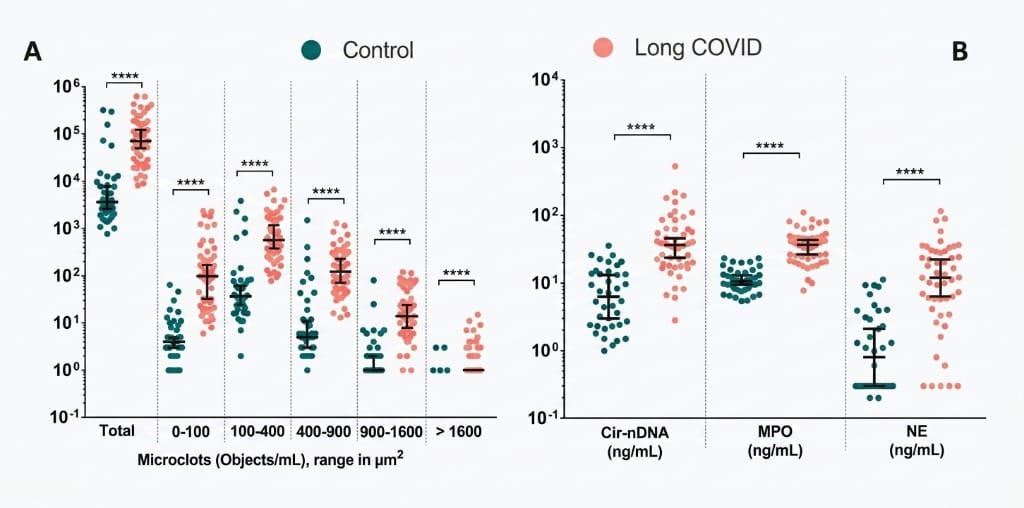
The same paper says the ME/CFS microclot load was lower than the lab had reported in acute COVID-19, Long COVID and even type 2 diabetes. So the answer to "are they the same?" is "similar stain, smaller amount, compared directly only once, in a 2024 preprint from the same lab, where Long COVID samples had about three times the microclot concentration." The 2021 Long COVID work and the larger count study use different imaging methods, so their numbers can't be lined up with the ME/CFS percentages.
The independent UK count study is useful for a different reason. It was a preprint of 129 people, and about half of the Long COVID samples had counts similar to controls. The authors also saw no clear link between count and symptoms, and said they were studying ME next.
Are microclots found in POTS?
Only preliminary data exist. The Pretorius and Kell group tested plasma from healthy controls, people with POTS from before the pandemic, Long COVID and Long COVID with POTS. In the preprint, microclot levels by imaging flow cytometry were higher in the disease groups but the difference wasn't statistically significant. The published 2026 paper focused on chemical modifications of the trapped proteins, with 18 to 20 people per group, and calls itself a preliminary study.
You may see clinical observations about POTS and microclots in news coverage. Those are anecdotes and clinic experience, not group data, so we don't count them as evidence.
Next step
Curious whether amyloid fibrin material is visible in your own blood?
Our at-home amyloid fibrin test is observational, not a diagnosis, and a result needs a clinician's interpretation.
Is there a link between fibromyalgia and microclots?
We searched the literature in November 2026 and found no study that measured microclots in fibromyalgia. The only connection on record is that 4 of the 25 ME/CFS patients in the 2022 study also reported fibromyalgia, and that study wasn't built to compare them. Anyone telling you fibromyalgia is a microclot disease is going beyond the published data.
Why isn't a microclot result specific to one disease?
The same group has described amyloid-type clotting well beyond post-viral illness. A 2018 Scientific Reports study reported aberrant, ThT-positive clots in people with Parkinson's disease, Alzheimer's-type dementia and type 2 diabetes. The ME/CFS paper itself notes that the same lab had found an even higher load in type 2 diabetes.
That matters for interpretation. If amyloid-like fibrin turns up in many inflammatory conditions, a positive result tells you something is going on, not what. It can't separate ME/CFS from POTS, Long COVID, diabetes or ordinary inflammation. For how that plays out in a real report, see what a positive amyloid test means.
What do critics and the ME Association say?
The 2023 Cochrane review by Fox and colleagues argued that "microclots" is the wrong word for these particles, because amyloid isn't part of a true thrombus. Pretorius and Kell and others dispute that framing; our page on whether microclots are real sets out both sides.
The ME Association, a UK patient charity, answered a reader's question in spring 2024. It called the role of micro-clots in Long COVID and ME/CFS "uncertain and controversial" and the ME/CFS connection "highly speculative and unproven". It said clotting specialists weren't convinced because other reputable groups hadn't repeated the findings. It added that it would fund ME/CFS research if a Long COVID link were firmly established. Since then, the independent UK count preprint has appeared, though it isn't peer reviewed.
Should people with ME/CFS get a microclot test?
No validated clinical test exists, and no reference range, so a result can't diagnose ME/CFS or choose a treatment. How to test for microclots covers the research method and its limits. Some people still want observational data to bring to a clinician, which is a personal call.
Whether to start, stop or combine any medicine or supplement belongs with your clinician, particularly anticoagulants or antiplatelets, which can cause bleeding. See our overview of microclot treatment for what has and hasn't been tested, and our Long COVID survival guide for practical pacing and support. If you notice a swollen painful leg, sudden breathlessness, chest pain or one-sided weakness, get emergency care at once, because those can signal a large clot or stroke that no microclot result explains.
Where our at-home test fits
Our amyloid test is a finger-prick dried blood sample, stained with Thioflavin T and imaged under blue-light microscopy at a partner laboratory in Mexico City. The report counts glowing shapes and measures their size. It is not a diagnostic test, and it hasn't been validated against the venous platelet-poor-plasma method used in the studies above. It can't tell you whether you have ME/CFS, POTS or fibromyalgia, and the results shouldn't be assumed to change your care.
For background on the underlying biology, read about the research behind fibrin amyloid microclots and how it connects to Long COVID. The researchers behind this work and the difference between microclots and ordinary blood clots are also worth reading before you decide what a result means for you.
Frequently asked questions
Do people with ME/CFS have microclots?
In one 2022 pilot study, plasma from 25 people with ME/CFS showed more Thioflavin T-positive fibrin(ogen) particles than plasma from 15 healthy controls. The burden was lower than the authors' earlier Long COVID results. It is a single small study from one lab, and independent replication is still needed.
Are microclots found in POTS?
Only preliminary data exist. A 2025 preprint from the Pretorius and Kell group, later published as a proteomic study, tested pre-COVID POTS, Long COVID and Long COVID-POTS samples. Microclot levels were higher in disease groups but not significantly so. The strongest findings concerned protein modifications, not counts, and no clinical conclusion follows.
Is there a link between fibromyalgia and microclots?
We searched the literature and found no study that measured microclots in people with fibromyalgia. Four of the 25 ME/CFS patients in the 2022 study also reported fibromyalgia, but that study wasn't designed to compare them. Any claimed link is currently speculation, not published data.
Should people with ME/CFS get a microclot test?
There's no validated clinical test, no reference range and no proven treatment tied to a result, so a test can't diagnose ME/CFS or guide care on its own. Some people still want observational data to discuss with a clinician. Whether to start or change any medicine is a decision for your clinician, not a test result.
Are microclots in ME/CFS the same as in Long COVID?
They were measured with the same Thioflavin T staining method, but the ME/CFS burden was lower than the lab's Long COVID findings, and in the one direct comparison, a 2024 preprint from the same lab, Long COVID samples had about three times the microclot concentration of ME/CFS samples. Whether the particles have the same cause or meaning is unknown.
Sources
- The Occurrence of Hyperactivated Platelets and Fibrinaloid Microclots in Myalgic Encephalomyelitis/Chronic Fatigue Syndrome (ME/CFS). Pharmaceuticals, 2022
- Flow Clotometry: Measuring Amyloid Microclots in ME/CFS, Long COVID, and Healthy Samples with Imaging Flow Cytometry. Research Square, 2024
- Persistent clotting protein pathology in Long COVID/Post-Acute Sequelae of COVID-19 (PASC) is accompanied by increased levels of antiplasmin. Cardiovascular Diabetology, 2021
- Increased fibrinaloid microclot counts in platelet-poor plasma are associated with Long COVID (preprint). medRxiv, 2024
- Post-translational modifications in the insoluble fraction of platelet-poor plasma distinguish pre-COVID-19 Postural Orthostatic Tachycardia Syndrome, Long COVID, and Long COVID-POTS - a preliminary study. Cardiovascular Diabetology, 2026
- Correlative Light-Electron Microscopy detects lipopolysaccharide and its association with fibrin fibres in Parkinson's Disease, Alzheimer's Disease and Type 2 Diabetes Mellitus. Scientific Reports, 2018
- Plasmapheresis to remove amyloid fibrin(ogen) particles for treating the post-COVID-19 condition. Cochrane Database of Systematic Reviews, 2023
- Micro-clots. The ME Association (ME Essential, Spring 2024), 2024
At-Home Amyloid Test
Curious whether amyloid fibrin material is visible in your own blood?
Our at-home amyloid fibrin test is observational, not a diagnosis, and a result needs a clinician's interpretation.
Next steps
- What Are Amyloid Microclots? Definition, Causes and EvidenceWhat are amyloid microclots? A plain definition of these fibrin particles in blood samples, how they form, what studies found and what Cochrane says.
- How to Test for Microclots: Methods, Labs and LimitsMicroclots test options compared: Thioflavin T microscopy, flow cytometry and at-home kits, why D-dimer misses microclots, and how to read a result.
- Micro Blood Clots Symptoms: Microclots Symptoms GuideMicro blood clots symptoms include fatigue, brain fog and breathlessness. Learn why microclots may cause capillary hypoperfusion and what tests can show.

Tim Ottowitz
Founder & Research Lead
Tim Ottowitz founded Amyloid Test and writes its Science Hub, turning fibrin amyloid and spike protein research into plain-language guides that stay close to the published evidence.
Keep reading
Amyloid Microclots: What the Research Shows So Far
What studies show about amyloid microclots in Long COVID: how fibrin forms them, why they resist breakdown, the key findings and the open questions.
Are Microclots Real? The Evidence For and Against
Are microclots real? A two-sided review of what several labs have seen, what the 2023 Cochrane review and other critics dispute, and what remains unproven.
Resia Pretorius Microclots: Who Is Behind the Research?
Resia Pretorius microclots explained: who she and Douglas Kell are, who their co-authors are, and what each key paper reported, plus who disagrees.