Are Microclots Real? The Evidence For and Against
Short answer
The particles are real: several labs have stained and counted them in plasma with Thioflavin T. What is disputed is the name, because critics say amyloid fibrin(ogen) particles are not clots; whether they cause Long COVID symptoms; and whether removing them helps. A 2023 Cochrane review found the evidence insufficient, and no validated test or proven treatment exists.
Key takeaways
- 1Thioflavin T-positive particles in plasma have been reported by several groups, so their existence is not the main dispute.
- 2Critics, including a 2023 Cochrane review, say the studies were small, mostly image-based and poorly standardised, so a link to symptoms is unproven.
- 3Healthy controls also show some particles in several studies, which makes the size and number of particles, not their presence, the question.
- 4No randomised trial has shown that removing or dissolving these particles helps, and no microclot test has a validated reference range.
- 5Both sides have published, and the people arguing most strongly have reviewed and criticised each other's work.
Yes, the particles are real: several labs have stained them in plasma with Thioflavin T and counted them. What's disputed is whether "microclots" is the right name, whether the particles cause Long COVID symptoms, and whether removing them helps. This page lays out each claim next to the evidence for it and against it, with study sizes, so you can see where the disagreement actually sits.
What do the studies actually show?
Here is the whole debate in one table. "Status" is our reading of the published record, not a verdict on either camp.
| Claim | Evidence for | Evidence against or limits | Status |
|---|---|---|---|
| Thioflavin T-positive particles exist in plasma | Reported by several groups in different cohorts, including a Liverpool haematology group studying ICU patients | The Cochrane review found the first studies relied heavily on selected images and gave no assay reliability data | Observed, method not standardised |
| They are higher in Long COVID | Flow cytometry study of 40 patients and 20 controls (2023); 50 patients and 38 controls (2025) | Small cohorts, overlapping research teams, healthy people also show particles; an independent 2026 UK study of never-hospitalised Long COVID (55 samples) found no difference from recovered controls | Reported by one team; one independent study found no difference |
| They are "clots" | They contain fibrin(ogen) and trapped proteins | Critics say amyloid particles are not the fibrin, platelet and red-cell mesh of a clot | Dispute about terminology |
| They cause symptoms | Proposed mechanism: blocking small vessels | No study has shown that they do, and healthy people also carry some | Hypothesis |
| Removing them helps | A preliminary report on triple anticoagulant therapy | No randomised trial of plasmapheresis was found by Cochrane; the other treatment evidence is preliminary | Unproven |
| They predict outcomes in critical illness | 104 ICU patients: microclots linked to disseminated intravascular coagulation and 28-day mortality | Single study, a different condition than Long COVID | Promising, needs replication |
Where did the microclot findings come from?
In 2021, Pretorius and colleagues reported in Cardiovascular Diabetology that plasma from Long COVID patients contained large anomalous deposits that resisted breakdown. The study compared 11 Long COVID patients with 13 healthy volunteers, 15 acute COVID-19 patients and 10 people with type 2 diabetes. That's a small laboratory study, using microscopy and proteomics.
A 2022 Biochemical Journal review by Kell, Laubscher and Pretorius argued these fibrin amyloid particles could block capillaries and underpin many Long COVID symptoms. It cited a preliminary report that triple anticoagulant therapy removed both the particles and the symptoms. It's a hypothesis paper rather than a trial. For the background science, see our guide to fibrin amyloid microclots research and our definition of microclots.
Has anyone else seen them?
Partly. A Liverpool group led by haematologist Cheng-Hock Toh published the most independent-looking replication in Blood Advances in 2024. Schofield and colleagues stained platelet-poor plasma from 104 critically ill ICU patients. Microclots appeared in 44 of them (42.3%) and in none of the 20 healthy controls. Patients with a high number or larger microclots were more likely to develop disseminated intravascular coagulation (odds ratio 51.4, with a very wide confidence interval of 6.3 to 6,721) and to die within 28 days (odds ratio 5.3). This was an ICU cohort, not Long COVID.
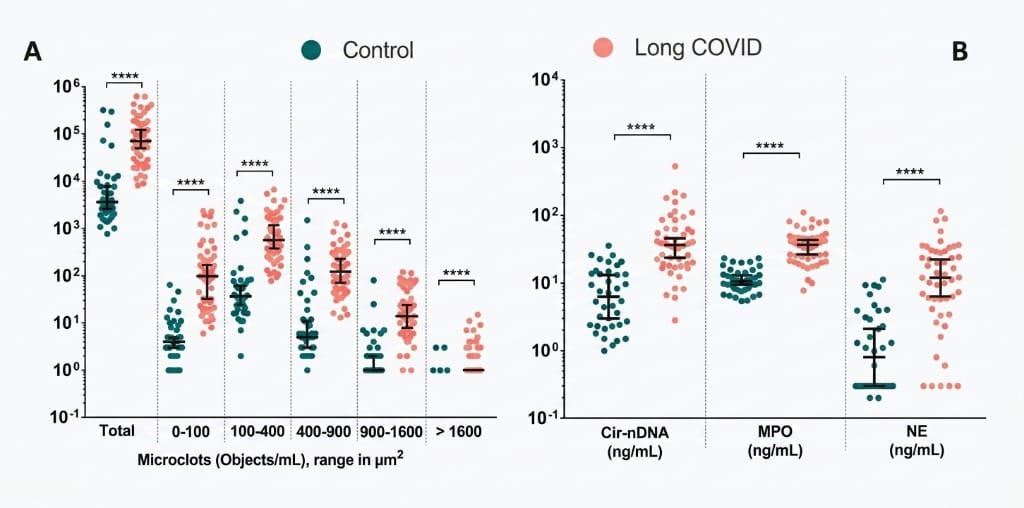
For Long COVID itself, most data still come from the Stellenbosch team. A 2023 flow cytometry study of 40 Long COVID patients and 20 controls added objective counting to what had been microscope grading. A 2025 Journal of Medical Virology paper, with co-authors from Montpellier, found higher microclot counts and higher neutrophil extracellular trap (NET) markers in 50 Long COVID patients than in 38 healthy controls. We cover it in microclots and NETs in Long COVID.
What did the Cochrane review say about microclots?
The 2023 Cochrane review by Fox and colleagues set out to ask whether plasmapheresis helps. It first appraised the laboratory work, found five studies, and found amyloid fibrin(ogen) particles in people with post-COVID condition, healthy people and people with diabetes. Three studies relied on images without quantifying particle amount or size, and the risk-of-bias assessment showed concerns about conduct and reporting.
The reviewers concluded the evidence was insufficient to say the particles are linked to post-COVID condition, or whether people with it have more than healthy controls. They found no randomised trials of plasmapheresis, and said it shouldn't be used for this purpose outside a well-conducted trial. They also argued "microclots" is the wrong word, because amyloid is not part of a thrombus. Note what the review did not say: it didn't claim the particles are an artefact. Our summary of the treatment side is in plasmapheresis for Long COVID.
Why do some doctors push back?
In 2024, Hunt and colleagues (several of them Cochrane authors) argued in Research and Practice in Thrombosis and Haemostasis that the inferences for the thrombosis hypothesis aren't based on evidence. They said unlicensed antithrombotic medication isn't justified and apheresis should be reserved for well-designed trials. A follow-up letter titled "Reported particles are not blood clots" repeated three concerns: no individual sample data in the early papers, no published inter-assay variability, and no statistical comparison of particles in patients versus healthy controls.
Their practical worry is also worth stating: they say publicity has sent patients toward apheresis and triple anticoagulant therapy, which carry known adverse effects and no proven benefit. That's a safety argument, not only a scientific one. For the clot-versus-microclot distinction, see microclots vs blood clots.
Next step
Curious whether Thioflavin T-positive material shows up in your own sample?
Our at-home amyloid fibrin test provides observational microscopy data you can discuss with your clinician. It isn't a diagnosis.
What is the reply from the researchers?
Kell, Khan and Pretorius replied in 2024 that the critics repeated points they had already rebutted, and that several critics were also authors of the Cochrane review they were relying on. They stated that the Cochrane group had declined to append an online comment. They argue the theory rests on a decade of work and over 60 joint publications, that the spike protein induces amyloid microclots in normal plasma, that fibrin is found inside them, and that the ICU study showed prognostic value. They also invited critics to work together on the nature of the particles and the terminology.
Both letters agree on more than the tone suggests. Neither side says the particles are invented, and both call for better experiments. The disagreement is over whether current evidence is enough to act on, which is a judgment, not a fact.
Do healthy people have microclots?
In several studies, yes. The Cochrane review noted particles in healthy people. The 2025 paper reported that all patients with Long COVID and almost all healthy individuals had some microclots up to 30 micrometres, with counts significantly higher in patients. The ICU study found none in 20 healthy controls, so detection depends on the stain, the protocol and the cohort.
That's why a single count means little. Without a reference range, a result can't tell you whether your number is high. See how microclot testing works and how it differs from D-dimer.
So what can you actually do?
Treat microclots as an active research question. If you have ongoing symptoms, a clinician can rule out common and treatable causes with standard tests. Whether to take any blood thinner, antiplatelet or supplement is a medical decision that belongs with your clinician, because these can cause bleeding and interact with other medicines. Our microclots treatment overview covers what's been tried and how weak the evidence is.
Large clots are different. Sudden chest pain, severe breathlessness, a swollen painful leg, one-sided weakness or confusion could be a pulmonary embolism, DVT or stroke and need emergency care immediately, whatever any microclot result says.
Where an at-home test fits
Our at-home amyloid test is a finger-prick dried blood sample, stained with Thioflavin T and imaged at a partner laboratory in Mexico City. The report counts the glowing shapes and measures their size. It's not a diagnosis and not a medical device. It also hasn't been validated against the venous platelet-poor-plasma method used in the research above, so it can't settle the debate for you. If you want to see the method, read our amyloid fibrin test guide and the profile of the researchers behind the science.
Bottom line
The strongest honest statement is this: particles that stain with Thioflavin T exist, other groups have seen them, and their meaning is unsettled. Until a controlled study ties them to symptoms or shows that removing them helps, "real" describes the observation, not the explanation.
The same particles have been reported outside Long COVID, which we cover in microclots in ME/CFS, POTS and fibromyalgia.
Frequently asked questions
Are microclots real or just a theory?
Thioflavin T-positive particles in plasma are an observation reported by several research groups, not just a theory. The theory is the next step: that these particles block small vessels and cause Long COVID symptoms. That causal link has not been shown in a controlled trial, and critics dispute that the particles should be called clots.
Have microclots been debunked?
No. Neither side has settled it. The 2023 Cochrane review judged the laboratory evidence insufficient to link the particles to post-COVID symptoms, but it did not show the particles don't exist. Later studies, such as a 2024 ICU study of 104 patients, kept finding them. The honest status is unproven, not debunked and not confirmed.
What did the Cochrane review say about microclots?
The 2023 Cochrane review (Fox et al.) appraised five laboratory studies and found amyloid fibrin(ogen) particles in people with post-COVID condition, healthy people and people with diabetes. It judged the studies at risk of bias, found no randomised trials of plasmapheresis, and said plasmapheresis shouldn't be used for this outside a well-conducted trial.
Why do some doctors not believe in microclots?
Published critiques give several reasons. Early studies were small and relied on selected microscope images, assay reliability data were missing, healthy people also show particles, and the particles are amyloid forms of fibrin(ogen) rather than the fibrin, platelet and red-cell mesh of a classic clot. Critics also worry about patients taking blood thinners or apheresis without proven benefit.
Do healthy people have microclots?
Often yes, in small amounts. The Cochrane review noted particles in healthy people, and a 2025 study reported that almost all healthy controls had some microclots up to 30 micrometres while counts were higher in Long COVID. A 2024 ICU study, however, found none in its 20 healthy controls, so results vary by lab and method.
Is there an approved test for microclots?
No. Microclot staining is a research method, with no approved clinical test, standard protocol or agreed reference range. Standard clotting tests like D-dimer measure something different. A result from any microclot assay is observational information to discuss with a clinician, not a diagnosis.
Sources
- Persistent clotting protein pathology in Long COVID/Post-Acute Sequelae of COVID-19 (PASC) is accompanied by increased levels of antiplasmin. Cardiovascular Diabetology, 2021
- A central role for amyloid fibrin microclots in long COVID/PASC: origins and therapeutic implications. Biochemical Journal, 2022
- Accelerating discovery: A novel flow cytometric method for detecting fibrin(ogen) amyloid microclots using long COVID as a model. Heliyon, 2023
- Microclots, as defined by amyloid-fibrinogen aggregates, predict risks of disseminated intravascular coagulation and mortality. Blood Advances, 2024
- Circulating Microclots Are Structurally Associated With Neutrophil Extracellular Traps and Their Amounts Are Elevated in Long COVID Patients. Journal of Medical Virology, 2025
- Plasmapheresis to remove amyloid fibrin(ogen) particles for treating the post-COVID-19 condition. Cochrane Database of Systematic Reviews, 2023
- Challenging the current hypothesis that thrombosis is responsible for the post-COVID-19 condition. Research and Practice in Thrombosis and Haemostasis, 2024
- Fibrinaloid microclots in long COVID: assessing the actual evidence properly. Research and Practice in Thrombosis and Haemostasis, 2024
- No evidence of hypercoagulability, altered fibrinolysis, or increased fibrin(ogen) microaggregates in never‐hospitalized long COVID. HemaSphere, 2026
- Reported particles are not blood clots, so anticoagulant drugs are not a plausible treatment. Research and Practice in Thrombosis and Haemostasis, 2024
At-Home Amyloid Test
Curious whether Thioflavin T-positive material shows up in your own sample?
Our at-home amyloid fibrin test provides observational microscopy data you can discuss with your clinician. It isn't a diagnosis.
Next steps
- What Are Amyloid Microclots? Definition, Causes and EvidenceWhat are amyloid microclots? A plain definition of these fibrin particles in blood samples, how they form, what studies found and what Cochrane says.
- How to Test for Microclots: Methods, Labs and LimitsMicroclots test options compared: Thioflavin T microscopy, flow cytometry and at-home kits, why D-dimer misses microclots, and how to read a result.
- Micro Blood Clots Symptoms: Microclots Symptoms GuideMicro blood clots symptoms include fatigue, brain fog and breathlessness. Learn why microclots may cause capillary hypoperfusion and what tests can show.

Tim Ottowitz
Founder & Research Lead
Tim Ottowitz founded Amyloid Test and writes its Science Hub, turning fibrin amyloid and spike protein research into plain-language guides that stay close to the published evidence.
Keep reading
Do Microclots Go Away? What the Research Does and Doesn't Show
Do microclots go away? No study has followed untreated people over time, so no timeline exists. Here's how clots clear and what the data allows.
Microclots in Eyes: What Retinal Imaging Does and Doesn't Show
Microclots in eyes: no study has imaged them in a living person, but retinal scans show small-vessel changes after COVID-19. See what that means.
Micro Clots in Legs, Fingers and Toes: What's Known
Micro clots in legs: how to tell a DVT from superficial phlebitis, COVID toes and Long COVID microclots, and what research does and doesn't show.