Aspirin for Microclots: What the Evidence Shows and Doesn't
Short answer
Nobody knows whether aspirin helps microclots. Aspirin is an antiplatelet: it stops platelets clumping but doesn't break down fibrin, and no trial has tested aspirin alone for microclots or Long COVID. It appears in one uncontrolled preprint of a three-drug regimen. Daily aspirin also raises major bleeding, so any decision belongs with your clinician.
Key takeaways
- 1Aspirin blocks platelet clumping by irreversibly inhibiting the COX-1 enzyme; it doesn't dissolve fibrin or the amyloid microclots described in Long COVID research.
- 2No randomized trial has tested aspirin alone for microclots or Long COVID.
- 3In the RECOVERY trial of 14,892 hospitalised COVID-19 patients, aspirin didn't lower 28-day mortality (17% vs 17%) and raised major bleeding from 1.0% to 1.6%.
- 4In ASPREE, daily low-dose aspirin in 19,114 older adults without heart disease raised major hemorrhage by 38% over about 4.7 years.
- 5Critics argue the particles aren't clots, so antithrombotic drugs aren't a plausible treatment; the microclot researchers disagree.
Does aspirin help microclots? Nobody knows, because no trial has tested it. Aspirin is an antiplatelet drug: it stops platelets clumping but doesn't break down fibrin, the protein that makes up microclots, and no study has given aspirin alone to people with Long COVID and measured microclots afterwards.
This page covers what aspirin does, where it shows up in microclot research, what hospital trials found, and the bleeding numbers. It doesn't tell you to start or stop anything. Decisions about aspirin belong with a clinician who knows your history.
How does aspirin work?
Aspirin irreversibly blocks the cyclooxygenase-1 (COX-1) enzyme in platelets, which stops them making thromboxane A2, a signal that makes other platelets stick together (Expert Review of Cardiovascular Therapy, 2007). Platelets can't make new enzyme, so the effect lasts for the life of each platelet.
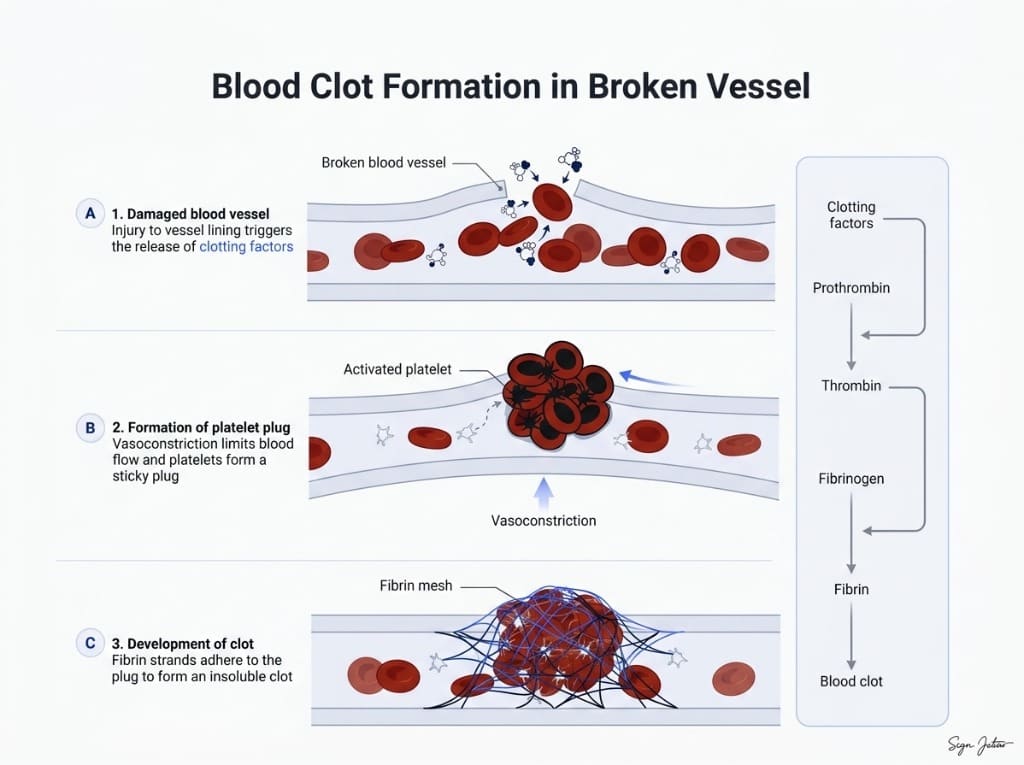
That's a different job from breaking up a clot. Platelet clumping is one step in forming a clot; the fibrin mesh is another. Aspirin acts on the first step. It doesn't cut fibrin, and it isn't an anticoagulant either. Microclot researchers describe particles that resist plasmin, the body's own fibrin-cutting enzyme (Pretorius et al., 2021), so a drug that only quiets platelets isn't expected to dissolve them.
Where does aspirin appear in microclot research?
Aspirin appears in one place: a 2023 preprint on "triple anticoagulant therapy" from the Pretorius group and South African clinicians. It followed 91 Long COVID patients who took clopidogrel and aspirin (dual antiplatelet therapy) plus the anticoagulant apixaban, with a stomach-protecting drug. Most patients reported symptoms resolving, and microclot and platelet scores fell (Research Square preprint, 2023). The authors reported no serious bleeding events.
The design limits what that shows. It had no control group, no blinding and no peer review, and the drugs were given together, so the effect of aspirin alone can't be separated out. Our full write-up is in triple therapy for long COVID. The same group's 2022 Biochemical Journal review is a hypothesis paper arguing that microclots and hyperactivated platelets together limit oxygen delivery in small vessels.
Are platelets hyperactive in Long COVID?
Some lab studies say so. A 2022 proteomic study of 99 Long COVID patients and 29 healthy controls found raised platelet factor 4 and von Willebrand factor and described significant platelet hyperactivation (Kruger et al., 2022). These were blood samples read under the microscope and in the mass spectrometer, not a test of any drug.
That's the logic for trying antiplatelets: if platelets are overactive, quieting them might help. It's a hypothesis, and an observed difference in platelets doesn't show that aspirin fixes the symptoms. For the wider science, see Resia Pretorius and the microclot research.
Does aspirin help in acute COVID-19?
Not clearly. In acute COVID-19 the largest test was the RECOVERY trial, a randomised, open-label trial in hospitals in the UK, Indonesia and Nepal. Of 14,892 patients, 7,351 got aspirin plus usual care and 7,541 got usual care alone. In each group 17% died within 28 days (rate ratio 0.96, 95% CI 0.89 to 1.04) (Lancet, 2022).
Aspirin did lower thrombotic events (4.6% vs 5.3%) and raise major bleeding (1.6% vs 1.0%). An earlier retrospective study of 412 US hospital patients linked aspirin use to lower ventilation and mortality after adjustment (Chow et al., 2021), but the authors said a randomised trial was needed. RECOVERY was that trial. Neither studied Long COVID or microclots, and hospital patients with acute infection differ from people with lingering symptoms.
Next step
Want data before you talk to a doctor about microclots?
Our at-home amyloid fibrin test records Thioflavin T microscopy of your sample. It's observational data for your clinician, not a reason to start a blood thinner.
What are the bleeding risks of daily aspirin?
Real, and measured. ASPREE randomised 19,114 adults aged 70 or older (65 or older for some groups) with no heart disease to low-dose aspirin or placebo for a median of 4.7 years. Major hemorrhage ran at 8.6 vs 6.2 events per 1,000 person-years (hazard ratio 1.38, 95% CI 1.18 to 1.62), and cardiovascular events didn't fall significantly (NEJM, 2018).
The US Preventive Services Task Force reached a cautious position in 2022: starting aspirin to prevent a first heart attack or stroke is an individual decision at ages 40 to 59 for people with a 10% or higher 10-year cardiovascular risk, and not recommended at 60 or older (JAMA, 2022). Those are heart-disease numbers, not Long COVID numbers, but they show that aspirin isn't a harmless default. Ask a doctor about your own risk before starting it, particularly with ulcers, other blood thinners or an upcoming procedure.
Do critics say antithrombotic drugs make sense?
Many don't. A 2024 letter from Fox, Hunt and colleagues argues the particles "are not clots," so "anticoagulant drugs are not a plausible treatment," and that such treatments have established adverse effects and no proven benefit (Res Pract Thromb Haemost, 2024). The microclot researchers reply that their data were misread. Our overview of the debate is in are microclots real.
Neither side has randomised trial data on aspirin.
How do aspirin, anticoagulants and enzymes compare?
| Drug class | What it acts on | Evidence for microclots | Main risk |
|---|---|---|---|
| Antiplatelet (aspirin, clopidogrel) | Platelet activation | Only inside a 91-patient uncontrolled preprint of triple therapy | Bleeding, especially stomach and brain |
| Anticoagulant (apixaban and similar) | Clotting factors that build fibrin | Same preprint; critics say particles aren't clots | Serious bleeding |
| Fibrinolytic enzyme supplements (nattokinase) | Fibrin directly | Lab dish studies only, with mixed results; see nattokinase for microclots | Bleeding, unregulated products |
None of these classes has a trial in microclot patients. Anyone mixing them raises the bleeding risk, which is why flare versus bleeding symptoms matter. Our microclot treatment overview places them alongside other approaches.
When is a symptom an emergency?
Call emergency services for sudden chest pain, sudden severe breathlessness, one-sided weakness, facial droop, slurred speech, a hot swollen painful leg or a sudden severe headache. These can signal a deep vein thrombosis, pulmonary embolism or stroke, and need care whatever any microclot result says. Black stools, vomiting blood or bleeding that won't stop also need urgent care for anyone on aspirin or other blood thinners. For ordinary clots versus microclots, see microclots vs blood clots.
Where does testing fit?
A microclot result can't tell you whether aspirin is safe or useful for you. There's no validated cutoff, and how to test for microclots explains what each method shows. Our at-home amyloid test uses a dried finger-prick sample and Thioflavin T microscopy, which the lab reports as a count and size of glowing shapes. It isn't a diagnosis, isn't validated against the venous platelet-poor-plasma research method, and doesn't promise that results change your care. Some people bring the report to a clinician as one more piece of data.
The next step is a conversation with a clinician about your bleeding risk, other medicines and what you'd track. For the bigger picture, start with what microclots are.
Enzyme products are ranked by evidence in supplements for microclots.
Frequently asked questions
Does aspirin dissolve microclots?
No evidence says it does. Aspirin isn't a fibrinolytic: it reduces platelet activity rather than breaking down fibrin. Microclot research describes amyloid fibrin particles that resist the body's own clot-dissolving enzyme, plasmin. No study has measured microclots before and after aspirin alone, so any claim that it clears them goes beyond the data.
Should I take baby aspirin for long covid?
That decision belongs with your clinician, not a web page. No trial has shown aspirin helps Long COVID, and in ASPREE daily low-dose aspirin raised major bleeding in older adults without heart disease. Your age, stomach history, other medicines and bleeding risk all matter, so ask before starting, and never stop prescribed aspirin on your own.
Is aspirin or nattokinase better for microclots?
Neither has been shown to help microclots in people. Aspirin acts on platelets; nattokinase is an enzyme that cuts fibrin. Nattokinase dissolved lab-made clots in one preprint but did not shrink plasma-derived microclots on its own in another study. With no head-to-head data, nobody can say which is better, and the choice is a clinician's call.
Can I take aspirin and nattokinase together?
Combining them raises a bleeding concern, and it's a decision for your clinician. Aspirin blocks platelets and nattokinase has fibrinolytic activity; a review of nattokinase also describes antiplatelet effects. No study has tested the pair in microclot patients. Tell whoever manages your medicines about every supplement, and don't combine them on your own.
Does clopidogrel help long covid?
Unknown. Clopidogrel is an antiplatelet that blocks the P2Y12 receptor on platelets. It appears only inside a three-drug regimen in an uncontrolled 91-patient preprint, so its separate effect can't be judged. It carries bleeding risk, especially alongside aspirin or an anticoagulant, and is prescribed by clinicians, not self-started.
Sources
- Clinical implications of aspirin resistance. Expert Review of Cardiovascular Therapy, 2007
- Treatment of Long COVID symptoms with triple anticoagulant therapy (preprint). Research Square, 2023
- A central role for amyloid fibrin microclots in long COVID/PASC: origins and therapeutic implications. Biochemical Journal, 2022
- Aspirin in patients admitted to hospital with COVID-19 (RECOVERY): a randomised, controlled, open-label, platform trial. The Lancet, 2022
- Aspirin Use Is Associated With Decreased Mechanical Ventilation, Intensive Care Unit Admission, and In-Hospital Mortality in Hospitalized Patients With Coronavirus Disease 2019. Anesthesia & Analgesia, 2021
- Proteomics of fibrin amyloid microclots in long COVID/post-acute sequelae of COVID-19 (PASC) shows many entrapped pro-inflammatory molecules that may also contribute to a failed fibrinolytic system. Cardiovascular Diabetology, 2022
- Persistent clotting protein pathology in Long COVID/Post-Acute Sequelae of COVID-19 (PASC) is accompanied by increased levels of antiplasmin. Cardiovascular Diabetology, 2021
- Effect of Aspirin on Cardiovascular Events and Bleeding in the Healthy Elderly (ASPREE). The New England Journal of Medicine, 2018
- Aspirin Use to Prevent Cardiovascular Disease: US Preventive Services Task Force Recommendation Statement. JAMA, 2022
- Reported particles are not blood clots, so anticoagulant drugs are not a plausible treatment. Research and Practice in Thrombosis and Haemostasis, 2024
- Nattokinase: A Promising Alternative in Prevention and Treatment of Cardiovascular Diseases. Biomarker Insights, 2018
At-Home Amyloid Test
Want data before you talk to a doctor about microclots?
Our at-home amyloid fibrin test records Thioflavin T microscopy of your sample. It's observational data for your clinician, not a reason to start a blood thinner.
Next steps
- Microclots Treatment: Every Approach Studied and the EvidenceMicroclots treatment compared in one table: anticoagulants, aspirin, nattokinase, apheresis, DNase and ultrasound, with the evidence and risks of each.
- Nattokinase for Microclots: What 8 Studies Found, Side by SideDoes nattokinase dissolve microclots? Eight studies compared side by side: what each tested, assumed and concluded, and where they disagree.
- H.E.L.P. Apheresis for Long COVID: Who Offers It, What Evidence ShowsH.E.L.P. apheresis for long COVID: what it is, who offers it, and what the evidence says, including the 2023 Cochrane review and DFPP results.

Tim Ottowitz
Founder & Research Lead
Tim Ottowitz founded Amyloid Test and writes its Science Hub, turning fibrin amyloid and spike protein research into plain-language guides that stay close to the published evidence.
Keep reading
Triple Therapy for Long COVID: 2026 Evidence and Bleeding Risks
What triple anticoagulant therapy for long COVID involves, what the only published cohort found, why haematologists object, and the bleeding risks.

Supplements for Microclots: Which Have Any Evidence?
Supplements for microclots ranked by evidence: nattokinase, lumbrokinase, serrapeptase and bromelain, what was tested in labs and what in people.
Nattokinase Flare vs Bleeding: Microclot Symptoms and Risks
Is your nattokinase flare a healing crisis or dangerous bleeding? Learn how to distinguish reperfusion symptoms from anticoagulant risks and microclots.