Neutrophil Extracellular Traps in Long COVID: The Microclot-NET Study
Short answer
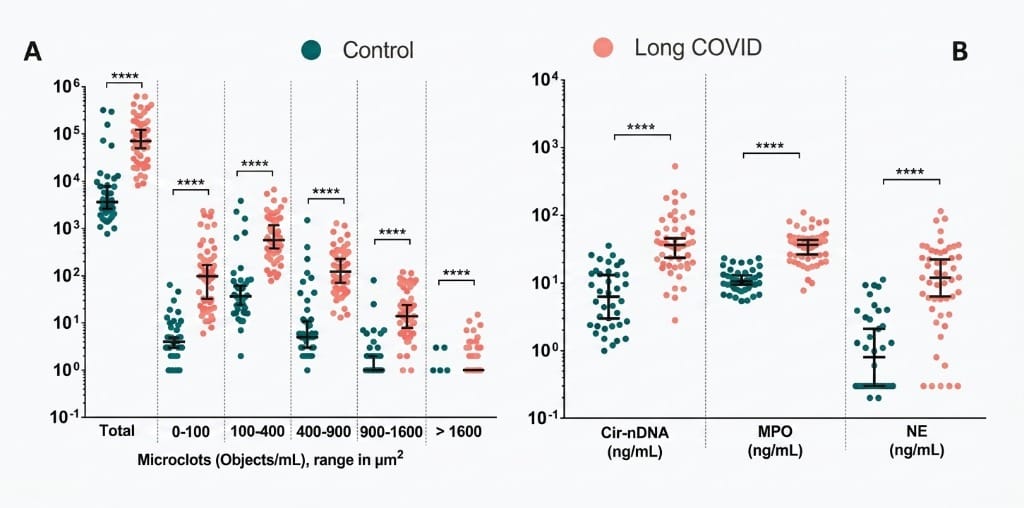
A 2025 study of 50 Long COVID patients and 38 healthy controls found more circulating microclots and higher NET markers (cell-free DNA, myeloperoxidase and neutrophil elastase) in Long COVID. Microclot burden tracked with NET markers, and microscopy showed NET material inside microclots. It's observational, so it links clotting and immune activation without proving they cause Long COVID.
Key takeaways
- 1Long COVID patients had more circulating microclots and higher NET markers than healthy controls from South Africa and France.
- 2Microclot counts and sizes tracked with circulating DNA, myeloperoxidase and neutrophil elastase.
- 3Microscopy showed DNA stains overlapping Thioflavin T-stained microclots, suggesting NET material sits inside some clots.
- 4Microclot counts separated Long COVID from healthy controls well (AUC around 0.90), but no disease-matched controls were tested.
- 5The study is observational and small, so it can't show what triggers the process or whether treating it helps.
Long COVID research often talks about two things separately: microclots and NETs (neutrophil extracellular traps). A 2025 paper argues they may be part of the same process. This walkthrough defines the terms first, then explains what the study did, what it found, and how much weight it can bear.
What did the 2025 microclot-NET study find?
The paper is Thierry, Usher, Sanchez and colleagues, Circulating Microclots Are Structurally Associated With Neutrophil Extracellular Traps and Their Amounts Are Elevated in Long COVID Patients, published in the Journal of Medical Virology in 2025. The team included Etheresia Pretorius and Douglas Kell, whose group first described fibrin amyloid microclots.
Its core claims, for this cohort:
- people with Long COVID had more circulating microclots
- they also had higher NET markers in plasma
- those two signals tracked together
- microscopy suggested NET material is physically part of some microclots
That doesn't explain all of Long COVID. It does strengthen the case that abnormal clotting and innate immune activation are working in the same process.
Start with the vocabulary
What is a microclot?
In this research, a microclot is a small clot-like particle in plasma that resists normal breakdown. Pretorius, Kell and colleagues describe many of them as fibrin amyloid microclots (also called fibrinaloid microclots), meaning the fibrin has folded into a tougher, amyloid-like form (Kell et al., 2022).
That doesn't mean every microclot is the same as the amyloid in Alzheimer's plaques. It does mean structural biology is a useful comparison: proteins that adopt ordered fibrillar shapes become unusually stable and hard to clear. We cover that background in amyloid-beta as immune defense, which looks at amyloid as a host-defense tool. For the clinical picture, see our pillar on amyloid microclots and Long COVID.
What are NETs?
Neutrophils are immune cells. One of their emergency moves is to throw out web-like nets made of their own DNA plus enzymes, which trap microbes. That's useful in infection, but it can turn harmful if it's excessive, poorly controlled or not cleared.
What is cirDNA?
Circulating cell-free DNA (cirDNA) is DNA floating in plasma. When NETs form and break down, DNA fragments end up in the blood, so cirDNA is a rough signal of NET activity.
What is fibrinolysis?
Think of clotting as "build the patch" and fibrinolysis as "take the patch down when it's no longer needed." Microclots matter because they seem to resist that cleanup.
The short version
- microclots = tiny, stubborn clot-like bits
- NETs = immune webs
- cirDNA = scraps from those webs
- fibrinolysis = the body's clot cleanup crew
What did the researchers do?
The study compared:
- 50 people with Long COVID
- 38 healthy controls: 14 from South Africa and 24 French blood donors
They measured:
- the number and size of microclots, using Thioflavin T (ThT) fluorescence microscopy
- three NET-related markers in plasma: myeloperoxidase (MPO), neutrophil elastase (NE) and cirDNA
They also stained samples for DNA alongside ThT to ask a harder question: are NET components just raised in the same patients, or are they part of the microclots themselves? That's what makes this more than a "marker A is up and marker B is up" study.
ThT is the same amyloid dye used in other microclot research. If you want to know how ThT detection of fibrin amyloid works, our amyloid fibrin test guide explains it.
Clinical next step
Want help making sense of microclot research?
Explore screening options, understand what current testing can and cannot show, and take the next step with a qualified clinician.
Start screeningWhat were the main findings?
1. Long COVID patients had more microclots
The Long COVID group had far more circulating microclots than healthy controls: a 19.7-fold median difference, with higher counts in every size range measured. That's consistent with earlier microclot work, now tied more directly to immune-trap biology. The fibrin amyloid microclots research summarizes those earlier studies.
2. NET markers were higher too
The Long COVID group had higher MPO, NE and cirDNA. These aren't generic inflammation markers: they point specifically to neutrophil activation and NET activity.
Neutrophil elastase is interesting for another reason. It's the same enzyme that can cut spike protein into amyloid-forming fragments in the lab, as covered in how neutrophil elastase turns spike protein into amyloid.
3. Microclots and NET markers moved together
The number and size of microclots correlated with the NET markers. In plain English, when NET signals were higher, microclot burden tended to be higher too. That doesn't prove cause, but it makes "these are unrelated" harder to defend.
4. Microscopy suggests NETs sit inside microclots
This is the strongest claim and deserves the most careful reading. DNA stains overlapped ThT-stained microclots, which the authors interpret as NET material embedded in the clots.
If that holds up, a microclot isn't just a clotting artifact. It's a mixed immune-and-clotting object, and that's a meaningful shift.
5. The markers separated patients from controls
Microclot counts discriminated Long COVID from healthy controls well, with an area under the ROC curve of about 0.90 for total microclot count. The NET markers also separated the groups, with AUCs of 0.85 to 0.94 alone and 0.95 combined.
That doesn't mean there's now a validated Long COVID test panel. The authors note they didn't include disease-matched controls, such as people with other inflammatory conditions, so specificity is unknown.
What is immunothrombosis?
- immuno = immune system
- thrombosis = clotting
Immunothrombosis means the immune and clotting systems acting together. During infection that can be protective, a way to wall off a threat. The concern in Long COVID is a combined response that lasts longer than it should or doesn't fully resolve. The same authors have proposed feedback loops in which inflammation, clotting and autoimmunity keep neutrophils switched on (Thierry & Salmon, 2024).
Why does this paper matter?
One line of Long COVID research focuses on abnormal fibrin, poor blood flow, small-vessel problems and clot material that resists cleanup. Another focuses on persistent innate immune activation, neutrophil dysregulation and NETs. This paper suggests they may be two views of the same event.
It also sharpens the next question: if NETs are inside microclots, why doesn't the body clear them? Part of the answer may be enzymes called DNases, which digest NET DNA. Hospital studies found reduced DNase activity in COVID-19, which we explain in DNase and NET clearance in Long COVID.
What the paper does not prove
It doesn't prove:
- that every Long COVID patient has this biology
- that microclots are the single cause of all Long COVID symptoms
- that NETs are the original trigger rather than one part of a larger loop
- that current assays are standardized enough for routine clinical use
- that changing these markers will improve how patients feel
It also leaves open questions:
- will independent labs get the same results?
- how sensitive are the findings to sample handling and assay methods?
- do different symptom clusters show different patterns?
- do the markers rise and fall with symptom severity over time?
- which treatments, if any, change both the biology and the symptoms?
That's not a flaw. It's the difference between a meaningful study and a settled body of evidence.
How should you read this study?
Read it as a careful observational study with a plausible mechanism, one that ties immune webs and clot biology together more directly than earlier work. It still needs replication, standardization and follow-up.
Practical questions to keep asking: can it be replicated, how reliable are the assays, which part of the patient population does it describe, and what changes when a patient improves? That's how to avoid both overstatement and dismissal.
What can you do with this today?
Standard clotting tests, such as D-dimer, weren't designed to find fibrinolysis-resistant microclots; our comparison of D-dimer vs microclot testing explains why. Microclot research uses ThT fluorescence microscopy instead.
Our amyloid fibrin test applies that ThT method to a finger-prick dried blood sample and returns a videographic microscopy report you can share with your doctor. It doesn't measure NET markers like cirDNA, MPO or neutrophil elastase, and it isn't a diagnosis. For clinicians and centers that work with microclot findings, see our list of microclot testing labs and treatment centers, and for day-to-day steps, the Long COVID survival guide.
The bottom line
In at least some people with Long COVID, abnormal clot material and immune-web material may be part of the same physical process. The Thierry study supports a model where innate immune activation and abnormal clotting are linked, while still needing replication, standardization and clinical follow-up.
This article is educational and doesn't diagnose illness or recommend treatment.
Frequently asked questions
What are neutrophil extracellular traps?
Neutrophil extracellular traps, or NETs, are web-like structures that neutrophils, a type of white blood cell, release to catch microbes. They're made of the cell's own DNA studded with enzymes such as myeloperoxidase and neutrophil elastase. They help fight infection, but too many NETs, or NETs that aren't cleared, can damage blood vessels and promote clotting.
Are NETs higher in Long COVID?
In the 2025 Thierry study, people with Long COVID had higher levels of circulating DNA, myeloperoxidase and neutrophil elastase than healthy controls, which points to more NET activity. Earlier work by the same researchers reported similar signals. These are group-level findings from small cohorts, not a test that applies to every patient.
Can NETs be measured in a routine blood test?
Not in standard clinical panels. The markers used in research, such as cell-free DNA, myeloperoxidase-DNA complexes and neutrophil elastase, are mostly measured in research labs with assays that aren't standardized for routine diagnosis. Ask a clinician which tests, if any, make sense in your situation.
Do NETs cause Long COVID?
That hasn't been shown. The study found NET markers and microclots rise together and that NET material appears inside microclots, which suggests the two processes are linked. It can't tell whether NETs start the problem, keep it going, or are one part of a larger loop involving inflammation and clotting.
Sources
- Circulating Microclots Are Structurally Associated With Neutrophil Extracellular Traps and Their Amounts Are Elevated in Long COVID Patients. Journal of Medical Virology, 2025
- A central role for amyloid fibrin microclots in long COVID/PASC: origins and therapeutic implications. Biochemical Journal, 2022
- Inflammation-, immunothrombosis,- and autoimmune-feedback loops may lead to persistent neutrophil self-stimulation in long COVID. Journal of Medical Virology, 2024
At-Home Amyloid Test
Want help making sense of microclot research?
Explore screening options, understand what current testing can and cannot show, and take the next step with a qualified clinician.
Next steps
- Amyloid-Beta Antimicrobial Peptide: Amyloid as an Immune DefenseIs amyloid-beta an antimicrobial peptide? How amyloid works as immune defense, what Meytal Landau's lab showed, and where spike protein fits in.
- What Are Microclots? A Plain-Language Guide to Amyloid MicroclotsWhat microclots are, how fibrin folds into amyloid microclots that resist breakdown, the symptoms researchers link to them, and how they're tested.
- How to Test for Microclots: Methods, Options and What Results MeanHow to test for microclots: the methods researchers use, why D-dimer can't detect them, where to get a microclot test and how to read the result.

Tim Ottowitz
Founder, CovidVaccineDetox
Tim Ottowitz leads research and content at CovidVaccineDetox, translating technical papers into clear, patient-facing explanations without sanding off the important details.
Keep reading
DNase and NET Clearance in Long COVID: Why Microclots May Persist
COVID-19 can lower DNase, the enzymes that clear NETs. What the DNase research means for lingering microclots in Long COVID, and what's still unproven.
D-Dimer vs Microclot Test: Why a Normal D-Dimer Can Miss Microclots
D-dimer vs microclot test compared: what each measures, why D-dimer can read normal in Long COVID, and how Thioflavin T microscopy finds fibrin amyloid.
Amyloid Microclots: What the Research Shows So Far
What studies show about amyloid microclots in Long COVID: how fibrin forms them, why they resist breakdown, the key findings and the open questions.