Microclot Testing Access and Cost Index 2026
Short answer
Microclot testing is not a standard hospital test, so prices depend on the route. An at-home Thioflavin T kit costs $160 USD (3,200 MXN). Private clinics often do not publish prices, and research studies may cover testing for eligible participants. No route has a validated diagnostic cutoff, so compare what is measured, where it is processed and what support you get.
Key takeaways
- 1At-home Thioflavin T testing is the only route with a public, fixed price: $160 USD or 3,200 MXN.
- 2Private clinic prices are usually quoted after inquiry and may include consultation, imaging or follow-up.
- 3Research studies can be free but have eligibility rules and do not provide a clinical diagnosis.
- 4Hospital laboratories do not routinely offer microclot imaging, and standard clotting tests do not replace it.
- 5A cheaper test is not automatically worse, but a report without images, method details or limits is hard to interpret.
Microclot testing sits outside standard clinical care, which makes cost and access hard to compare. One route has a public price. Others quote after inquiry, bundle testing with consultations, or enroll you in research. This index sets out what each route includes, what it costs when a price is public, and what it can actually show.
What this index compares
The table covers the four realistic routes: an at-home kit, a private clinic, a research study and a hospital laboratory. Prices change, so treat every figure as a snapshot dated October 2026, not a permanent quote.
| Route | Typical cost | Sample | Turnaround | What it can show |
|---|---|---|---|---|
| At-home Thioflavin T kit | $160 USD / 3,200 MXN | Dried finger-prick blood | Report within 1 day of lab receipt; 5 to 7 business days total | Thioflavin T-positive amyloid fibrin deposits under microscopy |
| Private clinic | Usually quoted after inquiry | Fresh blood or plasma | Days to weeks, depending on the lab | Clinic-specific imaging, sometimes with a consultation |
| Research study | Usually free for eligible participants | Venous blood or plasma | Weeks to months | Research data, not an individual diagnosis |
| Hospital laboratory | Standard clotting tests may be covered; microclot imaging is not routine | Venous blood | Hours to days for standard tests | Large-clot markers such as D-dimer, not microclots |
Why microclot test prices are opaque
A microclot test is not one standardized product. Labs differ in sample type, how long the sample sits before processing, whether they use Thioflavin T microscopy or imaging flow cytometry, and who reads the result. A clinic may include a consultation, a follow-up visit or repeat imaging in the price. A research study may cover the test but restrict enrollment.
That makes a single "market price" misleading. The useful comparison is the full package: collection, shipping, laboratory processing, imaging, interpretation and follow-up. Our guide to how microclot testing works explains the laboratory differences in more detail.
What the $160 at-home kit covers
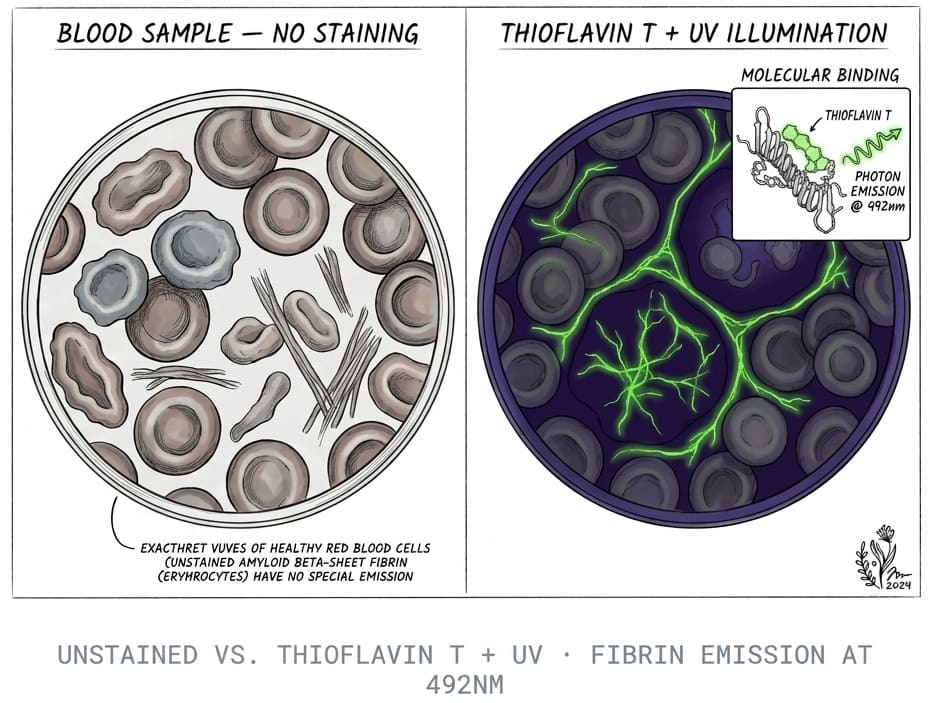
The at-home amyloid test is the only route with a public fixed price we can verify. It uses a finger-prick dried blood sample, Thioflavin T staining and 6K video microscopy at 20x magnification. The report is produced within one day of the laboratory receiving the sample, and kit delivery to report is typically five to seven business days including shipping.
The report is observational. It is not a diagnosis, not a medical device, and not a test for Alzheimer's disease or systemic amyloidosis. It does not measure D-dimer, fibrinogen or circulating spike protein. Those limits matter when you compare it with a clinic that offers a broader workup. Our comparison of at-home testing versus clinic testing covers sample stability and turnaround.
Questions to ask before paying
- Which sample do you use, and how is it transported?
- Do you use Thioflavin T fluorescence microscopy, imaging flow cytometry or another method?
- Who reads the images, and what training do they have?
- Does the report include raw images or video, or only a summary?
- Is the price itemized, and does it include consultation and follow-up?
- What can this test not tell me?
- Do you offer repeat testing, and what would a change mean?
If a provider cannot answer the method questions, the price is not the main problem. You cannot interpret a result without knowing what was measured.
Red flags in microclot testing offers
Be cautious when a provider promises a diagnosis, a cure, or a treatment plan based only on a microclot result. There is no validated diagnostic cutoff, and no treatment has been proven to remove microclots or change outcomes. A report should state its limits and should not be used to sell an unproven protocol.
Also check whether the provider names the laboratory, explains the sample handling, and gives you images you can share with your own doctor. Our guide to microclot testing labs and treatment centers lists the questions to ask about clinical programs.
How to choose a route
Choose a research study if you are eligible and want to contribute to evidence. Choose a clinic if you need a clinician to review your history alongside the test. Choose the at-home kit if you want a fixed price, a mail-in sample and a report you can bring to your own doctor. A hospital is the right place for standard clotting tests and emergency symptoms, not for routine microclot imaging.
For a wider comparison of home options, read our guide to the best at-home microclot test kits. If you are trying to understand what a positive result means, start with what a positive amyloid test means.
Methodology and limits
This index uses publicly listed pricing from the Amyloid Test product page and compares access routes described in the published research and our testing guides. We did not invent clinic prices. Where a price is not public, the table says so. The clinical status of microclot imaging is research-stage, and the absence of a validated cutoff is the most important limitation.
Costs and turnaround times change. Check the current product page and ask any clinic for an itemized quote before paying.
Frequently asked questions
How much does a microclot test cost?
The only publicly listed price we can verify is the at-home Amyloid Test kit at $160 USD or 3,200 MXN. That covers the collection kit, shipping, Thioflavin T staining, 6K video microscopy and a laboratory report. Private clinics usually quote after inquiry, and research studies may cover the cost for eligible participants.
Does insurance cover microclot testing?
Usually not as a microclot test. Standard clotting tests such as D-dimer, PT/INR and fibrinogen may be covered when a clinician orders them for a standard indication. Microclot imaging is research-stage and does not have a broadly accepted diagnostic code. Ask your insurer and the testing provider before you pay.
Why do private clinics not publish microclot test prices?
Clinics often bundle testing with a consultation, repeat imaging or follow-up, so the test price alone would be misleading. Some also use different sample types and counting methods. Ask for an itemized quote that separates the blood draw, laboratory processing, imaging, report and consultation.
Is a cheaper microclot test worse?
Not automatically. What matters is whether the sample is handled correctly, whether Thioflavin T imaging is used, who reads it and whether the report states its limits. A low price with no method details or images is harder to use than a higher price with a clear laboratory chain and a report you can discuss with a clinician.
Can I get a microclot test at a hospital?
Most hospital laboratories do not offer microclot imaging. They run standard clotting tests for large clots, such as D-dimer, PT/INR and fibrinogen. Those tests answer different questions and cannot confirm or rule out amyloid fibrin microclots. A hospital may support research, but routine clinical access is limited.
What should I ask before paying for a microclot test?
Ask which sample is used, whether Thioflavin T fluorescence microscopy is performed, who reads the images, what the report includes, whether raw images or video are provided, what the turnaround is, and what the test cannot tell you. Also ask whether the price includes a clinician review and repeat testing.
Sources
- A central role for amyloid fibrin microclots in long COVID/PASC: origins and therapeutic implications. Biochemical Journal, 2022
- Persistent clotting protein pathology in Long COVID/Post-Acute Sequelae of COVID-19 (PASC) is accompanied by increased levels of antiplasmin. Cardiovascular Diabetology, 2021
- Accelerating discovery: A novel flow cytometric method for detecting fibrin(ogen) amyloid microclots using long COVID as a model. Heliyon, 2023
- Circulating Microclots Are Structurally Associated With Neutrophil Extracellular Traps and Their Amounts Are Elevated in Long COVID Patients. Journal of Medical Virology, 2025
- Amyloid Test at-home kit. Amyloid Test, 2026
At-Home Amyloid Test
Compare the at-home route with the alternatives
The Amyloid Test kit uses Thioflavin T fluorescence microscopy and provides an observational report you can review with a clinician.
Next steps
- Amyloid Fibrin Test: How Fibrin Amyloid Microclots Are DetectedWhat an amyloid fibrin test is, how Thioflavin T microscopy spots fibrin amyloid microclots, how it differs from D-dimer, and what it can't tell you.
- Amyloid Fibril Test: Methods Used to Detect Amyloid FibrilsHow an amyloid fibril test works: Thioflavin T, Congo red, electron microscopy, X-ray diffraction and seeding assays compared, with which are clinical.
- Types of Amyloid Tests: Blood Tests, PET, CSF, Biopsy and MicroclotsCompare the types of amyloid tests: Alzheimer's blood tests, amyloid PET, spinal fluid, amyloidosis biopsy and fibrin amyloid microclot microscopy.

Tim Ottowitz
Founder & Research Lead
Tim Ottowitz founded Amyloid Test and writes its Science Hub, turning fibrin amyloid and spike protein research into plain-language guides that stay close to the published evidence.
Keep reading
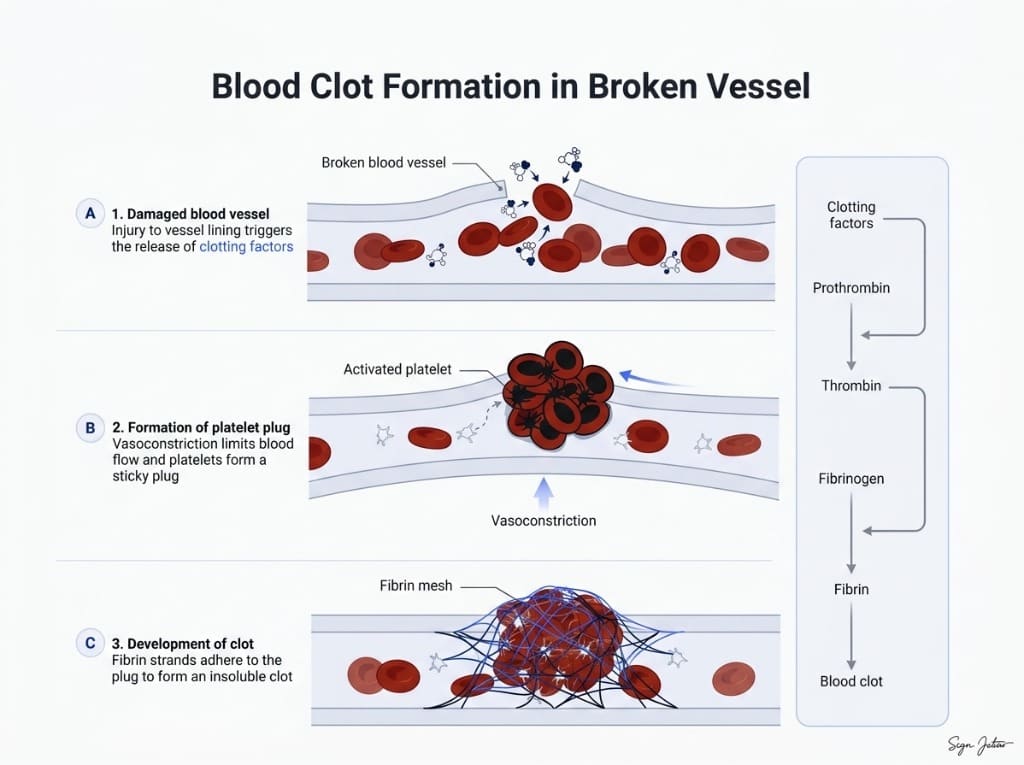
D-Dimer vs Microclot Test: Why a Normal D-Dimer Can Miss Microclots
D-dimer vs microclot test compared: what each measures, why D-dimer can read normal in Long COVID, and how Thioflavin T microscopy finds fibrin amyloid.
Amyloid Microclots Blood Test: Methods, Costs, and Home Kits
How to get an amyloid microclots blood test. Compare hospital research protocols with at-home ThT fluorescence microscopy kits, pricing, and turnaround.
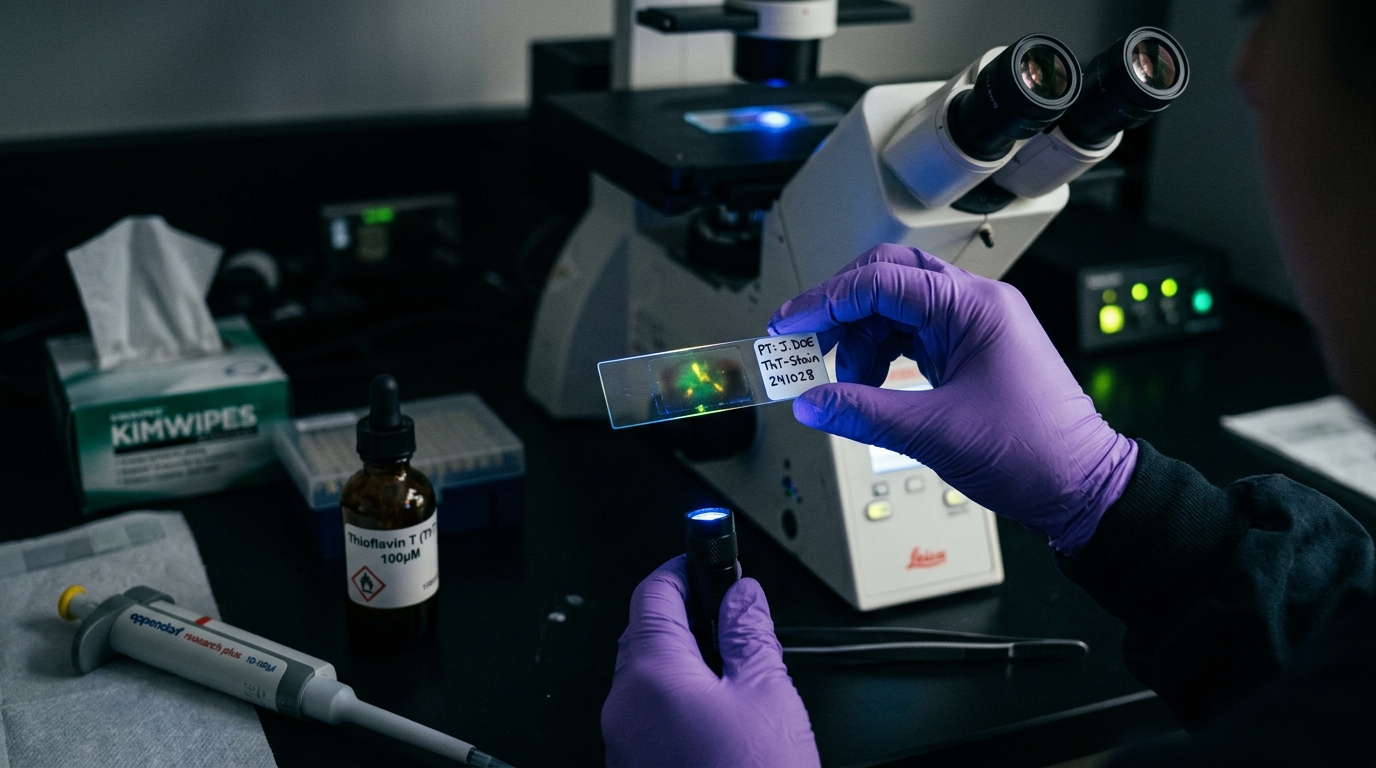
At-Home Microclot Test vs Clinic: Cost, Labs, and Accuracy
Compare at-home microclot tests with in-person clinic testing. Examine cost, wait times, sample stability, and 6K ThT fluorescence microscopy methods.