Microclot Testing Labs and Treatment Centers: How to Choose

Short answer
Microclot testing is offered by a few university research groups, usually through studies, and by a small number of private labs that use Thioflavin T fluorescence microscopy, including at-home finger-prick kits. Treatment centers mostly offer apheresis such as H.E.L.P. or DFPP, which is expensive, paid out of pocket and not yet backed by large controlled trials. Check methods, pricing and clinician oversight before booking.
Key takeaways
- 1Routine blood panels, including D-dimer, aren't designed to detect fibrin amyloid microclots.
- 2Testing options range from research-study enrolment to private Thioflavin T microscopy labs and at-home finger-prick kits.
- 3No microclot test has an agreed clinical reference range yet, so treat results as observational data for a clinician.
- 4Apheresis for Long COVID is offered privately in several countries, but evidence is limited to small studies and proposals.
- 5Ask any provider about method, pricing, licensing and who interprets your results before you commit.
This guide is for patients and referring clinicians trying to work out where to get microclot testing and what treatment centers actually offer. It explains the main types of provider, what each can and can't tell you, and the questions worth asking before you spend money or travel. We've kept it general on purpose: we only name providers whose claims we can check.
Why is microclot testing hard to find?
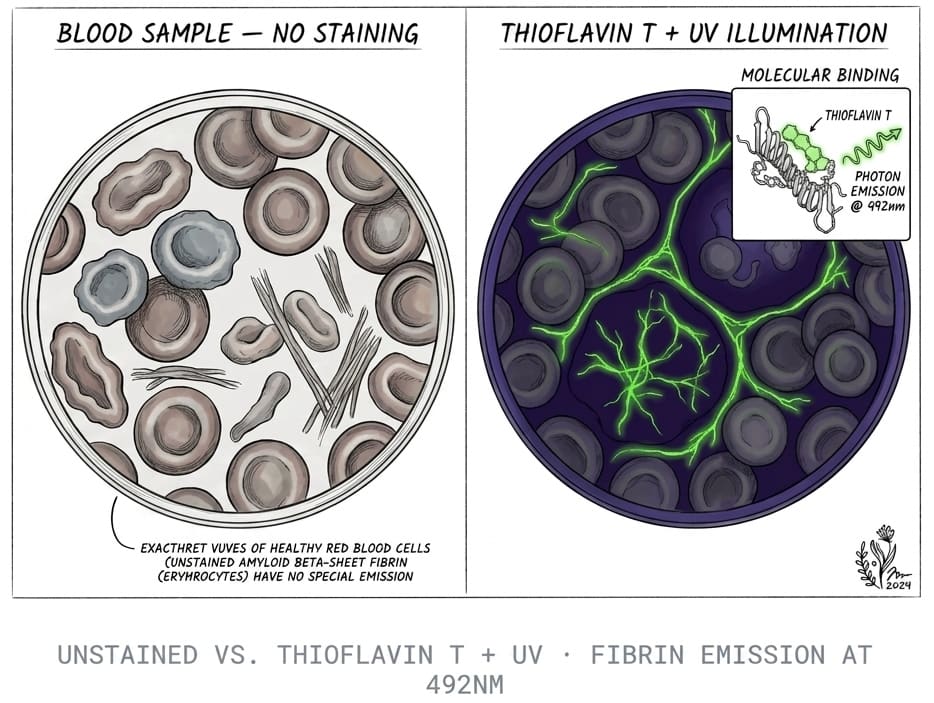
Fibrin amyloid microclots aren't part of any standard blood panel. D-dimer, full blood counts and routine clotting tests measure other things, which is why they often come back normal, as explained in D-dimer vs microclot testing. Detecting microclots needs Thioflavin T (ThT) staining and fluorescence microscopy, the approach described in the amyloid fibrin test guide.
Very few labs run it outside research. There's also no agreed clinical reference range, so even good labs report observational data rather than a diagnosis.
Five questions to ask any microclot testing lab
Use the same five questions for any provider, including us.
- Method: Does it use ThT fluorescence microscopy in line with the published research (Pretorius, Kell and colleagues)? Can it explain how images are scored?
- Sample handling: How is the sample collected and stabilized in transit, and how does the lab guard against clotting caused by handling?
- Reporting: Do you get images or video, not just a label? Does the report say clearly that it isn't a diagnosis?
- Clinical link: Can you share results with your own clinician, or does the lab push you toward its own treatment?
- Transparency: Is the full price stated up front? Are licensing and the lab's location disclosed?
Where can you get microclot testing?
There are three broad routes. None is perfect, and the right one depends on how far you can travel and how much you want research involvement. Our step-by-step guide on how to test for microclots compares the methods behind each one, and what microclots are covers the basics if you're new to the topic.
University research programs
The method came out of academic groups, especially the Pretorius lab at Stellenbosch University and Kell's group at the University of Liverpool, along with collaborators in Europe (Pretorius et al., 2021; Thierry et al., 2025). Testing usually happens through studies, so access depends on open enrolment, location and eligibility.
The upside is scientific depth. The downside is that research results aren't always returned to participants in a form you can take to your doctor.
Private ThT microscopy labs
A small number of private labs now offer ThT microclot analysis. Their methods, pricing and reporting vary a lot, so run them through the five questions above. Be wary of any lab that grades results on a scale it can't explain or that ties testing to a treatment package.
At-home finger-prick kits
Our at-home amyloid test is one example, and we're naturally not neutral about it. You collect a finger-prick dried blood sample and mail it to a partner laboratory in Mexico City. The lab stains it with ThT, records 6K video microscopy at 20× magnification under UV light, and reviews the footage with AI-assisted fibril detection plus trained human oversight.
The report is usually ready within one day of the lab receiving your sample, and kit-to-report time is typically 5 to 7 business days including shipping. It costs $160 USD. It isn't a diagnostic test, it doesn't measure D-dimer or spike protein, and a clinician should interpret it.
Clinical next step
Request a clinical screening review
Share your case details and the ClearAmyloid team will review whether the protocol is a fit.
Start screeningWhat microclot treatment centers offer
Most dedicated centers offer some form of apheresis. Others combine oral enzymes, anticoagulant regimens and supportive IV therapies. Evidence for all of these in Long COVID is early.
Apheresis: H.E.L.P. and DFPP
Apheresis filters plasma outside the body and returns it.
H.E.L.P. apheresis (heparin-induced extracorporeal LDL/fibrinogen precipitation) removes fibrinogen and LDL, while double filtration plasmapheresis (DFPP) uses a second filter to remove large molecules. Jaeger and colleagues have proposed H.E.L.P. for Long COVID, but that paper is a perspective rather than a trial, and two authors declared a patent on the use (Jaeger et al., 2022).
Private clinics in Germany, Switzerland, Cyprus and elsewhere offer these treatments, typically as multi-session courses paid out of pocket. Before booking, ask about the clinic's medical licence, who supervises sessions, how complications are handled, and what outcome data they have beyond testimonials. Check your country's health regulator and recent news for warnings about the clinic.
Hospital-based apheresis abroad
Some hospitals in Mexico and other countries offer DFPP to international patients, often at lower prices than European private clinics. We haven't verified individual centers, so we don't list them here. Ask for the hospital's accreditation, the supervising specialist's credentials and a written cost estimate.
Oral enzymes and anticoagulant regimens
Nattokinase, lumbrokinase and serrapeptase are widely used, but the microclot data is mostly from lab experiments, as covered in nattokinase for microclots. Combination anticoagulant and antiplatelet regimens have been reported in case series and need specialist supervision because of bleeding risk (Kell et al., 2022).
Some researchers are also looking at the neutrophil side of clotting, including DNase enzymes that break down NETs. That work is still preclinical and is covered in DNases and NET clearance.
Testing and treatment options compared
| Option | Invasiveness | Evidence for Long COVID | Typical cost | Access |
|---|---|---|---|---|
| University research study | Venous blood draw | Source of the published data | Often free for participants | Depends on enrolment |
| Private ThT microscopy lab | Varies | Uses research method; no clinical reference range | Varies by lab | Varies |
| At-home amyloid fibrin test (ours) | Finger-prick | Uses research method; observational data | $160 USD | 5 to 7 business days |
| D-dimer and routine bloods | Venous blood draw | Not designed to detect microclots (comparison) | Often insured | Same day to 24 hours |
| Oral fibrinolytic enzymes | Oral | Mostly lab studies | Varies | Immediate, but needs medical advice |
| H.E.L.P. or DFPP apheresis | Venous access, several sessions | Small studies and proposals | High, usually out of pocket | Clinic scheduling, often travel |
What's a sensible order of steps?
Before travelling or paying for apheresis, most patients are better served by a stepwise approach.
- Check your symptoms. Our free symptom screening tool helps you organize what you're experiencing.
- Rule out urgent problems. Get standard assessment for anything acute, including D-dimer and imaging if a clot is suspected.
- Decide whether a microclot test adds anything. If you want another data point, compare the routes above. The types of amyloid tests guide explains how microclot microscopy differs from Alzheimer's and amyloidosis tests.
- Review results with a clinician. Our doctor directory lists practitioners experienced with amyloid-related care.
- Weigh treatment carefully. Start with the lowest-risk options your clinician supports, and keep a log so you can judge whether anything's helping. The Long COVID survival guide has a simple tracking method.
If you want the background research first, fibrin amyloid microclots research summarizes what's been found and what's still disputed, and microclots and NETs in Long COVID covers the immune side.
Frequently asked questions
How much does microclot testing cost?
Prices vary widely by provider and country. Research programs sometimes test participants at no charge, while private labs set their own fees. Our at-home Amyloid Test kit costs $160 USD (3,200 MXN). Insurance rarely covers microclot microscopy because it isn't an established diagnostic test, so ask for the full price, including shipping, before ordering.
Is apheresis for Long COVID covered by insurance?
Usually not. Apheresis is an approved treatment for some conditions, such as certain lipid disorders, but using it for Long COVID is considered experimental in most countries. Patients who travel for H.E.L.P. or DFPP typically pay out of pocket for several sessions, plus travel and accommodation. Ask the clinic for a written estimate and what happens if you need to stop early.
Can my regular doctor order a microclot test?
Most hospital and commercial labs don't offer fibrin amyloid microscopy, so your doctor probably can't order it through the usual channels. You can order a private test yourself and bring the report to your appointment. Many clinicians are open to reviewing it, especially if you also bring a symptom log and your previous test results.
How do I find a doctor who understands microclots?
Start with clinicians who already see Long COVID or ME/CFS patients, since they're most likely to know the research. Our doctor directory lists practitioners experienced with amyloid-related care. Wherever you look, ask how they decide on treatment, how they monitor bleeding risk, and what they'll do if a therapy isn't helping.
Sources
- Persistent clotting protein pathology in Long COVID/Post-Acute Sequelae of COVID-19 (PASC) is accompanied by increased levels of antiplasmin. Cardiovascular Diabetology, 2021
- A central role for amyloid fibrin microclots in long COVID/PASC: origins and therapeutic implications. Biochemical Journal, 2022
- Circulating Microclots Are Structurally Associated With Neutrophil Extracellular Traps and Their Amounts Are Elevated in Long COVID Patients. Journal of Medical Virology, 2025
- The potential of heparin-induced extracorporeal LDL/fibrinogen precipitation (H.E.L.P.)-apheresis for patients with severe acute or chronic COVID-19. Frontiers in Cardiovascular Medicine, 2022
At-Home Amyloid Test
Get Your Amyloid Test Kit Today
Simple at-home collection. Results in days.
Next steps
- Nattokinase for Microclots: What Studies Show About Enzyme TherapyDoes nattokinase dissolve microclots? A plain review of the lab evidence for nattokinase, lumbrokinase and serrapeptase, plus the safety risks.
- Amyloid Fibrin Test: How Fibrin Amyloid Microclots Are DetectedWhat an amyloid fibrin test is, how Thioflavin T microscopy spots fibrin amyloid microclots, how it differs from D-dimer, and what it can't tell you.
- Amyloid Fibril Test: Methods Used to Detect Amyloid FibrilsHow an amyloid fibril test works: Thioflavin T, Congo red, electron microscopy, X-ray diffraction and seeding assays compared, with which are clinical.
Tim Ottowitz
Keep reading
Protein Nanoparticles for mRNA Delivery: A Lipid-Free Alternative
How a Harvard team built ENTER, a lipid-free protein nanoparticle that carried mRNA, CRISPR and siRNA in cells and mice, and what the data can't show.
How to Test for Microclots: Methods, Options and What Results Mean
How to test for microclots: the methods researchers use, why D-dimer can't detect them, where to get a microclot test and how to read the result.
D-Dimer vs Microclot Test: Why a Normal D-Dimer Can Miss Microclots
D-dimer vs microclot test compared: what each measures, why D-dimer can read normal in Long COVID, and how Thioflavin T microscopy finds fibrin amyloid.