Is Spike Protein a Prion? What a 2026 Prion-Like Domain Review Shows
Short answer
No one has shown that spike protein is a classical, self-replicating prion. A 2026 narrative review argues spike has prion-like regions whose fragments may form amyloid and help amyloid-beta, tau or fibrinogen misfold. Parts of that model have lab support, but the review reports no new data and the full chain hasn't been shown in a living person.
Key takeaways
- 1"Prion-like" doesn't mean spike has been shown to be an infectious, self-replicating classical prion.
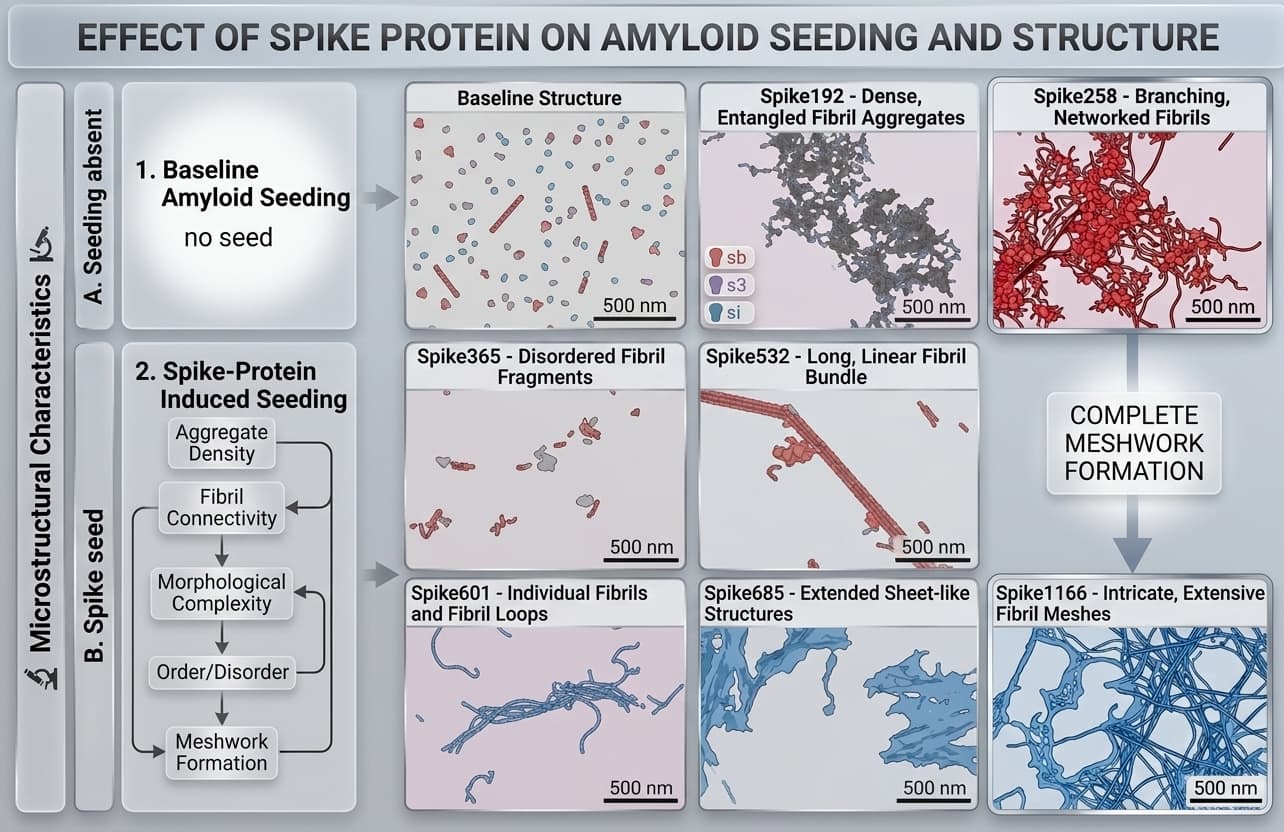
- 2Lab studies show some spike fragments form amyloid, and some spike fibrils disrupt fibrin formation and breakdown in vitro.
- 3Cross-seeding of amyloid-beta and tau by spike rests mainly on computer, test-tube and cell-model evidence.
- 4The 2026 paper is a narrative review: it enrolled no patients and generated no new data, so it can't establish clinical causation.
- 5Its treatment ideas, including enzymes and personalized peptides, haven't been shown to improve outcomes in people.
The word prion is frightening. It brings to mind rare, fatal brain diseases caused by proteins that fold wrong and teach other proteins to copy the bad shape. This guide looks at a 2026 review asking whether SARS-CoV-2 spike protein can do something similar, and it sorts what's been shown in the lab from what's still a hypothesis.
Is spike protein a prion?
No study has shown that it is. The review's own key limit is worth quoting in spirit: there's no direct evidence that intact spike is a classical, self-replicating prion.
The review's argument is narrower. Spike contains short regions that tend to form tightly stacked protein structures. When spike is cut, misfolded or translated incorrectly inside a stressed cell, some resulting pieces may turn sticky. Those pieces could then nudge other proteins, including amyloid-beta, tau or fibrinogen, into abnormal shapes.
That process is called cross-seeding. So this paper isn't evidence that COVID-19 or vaccination causes a contagious prion disease. It's a narrative review that assembles other studies into a proposed model.
The paper in one sentence
The authors propose that spike's aggregation-prone regions, combined with cell stress and abnormal protein fragments, may help seed amyloid-like structures and disrupt proteins in the brain, blood and other tissues.
The paper is Recombinant SARS-CoV-2 Spike Protein and Prion-Like Domains: Persistent Cross-Seeding of Amyloid-β and Tau, Transcriptional Instability, and Tissue Dysfunction by Catanzaro, McCullough and Hulscher. It was published in the International Journal of Innovative Research in Medical Science on September 11, 2026.
What does "prion-like" mean?
A classical prion is a misfolded protein that converts normal copies of the same protein into the abnormal shape. That self-propagating process causes diseases such as Creutzfeldt-Jakob disease.
Prion-like is a broader label. Researchers use it when a protein has sequence regions that favor aggregation, forms beta-sheet-rich structures, or helps other proteins misfold.
Here's one way to picture it. A classical prion is like a badly folded piece of origami that makes matching sheets fold the same wrong way. A prion-like protein may just be a crumpled, sticky sheet that helps a pile form. The second is concerning, but it isn't proof of the first.
The distinction matters because the review sometimes uses forceful language, while the evidence underneath ranges from computer predictions to test-tube experiments, cell models, case reports and observational studies.
The review's proposed chain of events
Spike is produced or persists
        ↓
Cells must fold and process it
        ↓
Cell stress, protein cutting, or translation errors create fragments
        ↓
Some fragments form beta-sheet-rich aggregates
        ↓
Those aggregates may seed abnormal folding in other proteins
        ↓
Protein cleanup systems become overloaded and tissues may be harmed
It's a useful way to organize the research. It isn't a single chain that one experiment has shown from start to finish in a person.
Does spike protein contain amyloid-forming segments?
Yes, at least in the lab. Proteins are long amino acid chains folded into 3D shapes, and short stretches can be more aggregation-prone than the folded whole.
Computer analysis has flagged prion-like domains in the spike sequence, and they differ across variants (Tetz & Tetz, 2022). Lab work went further. Nyström and Hammarström identified seven amyloid-prone spike sequences, and three of them met all their amyloid criteria (Nyström & Hammarström, 2022).
They also showed that neutrophil elastase, an enzyme released by immune cells, could cut full-length spike into amyloid-forming pieces. Intact folded spike didn't become amyloid on its own: cutting it mattered. We explain that step in detail in how neutrophil elastase turns spike protein into amyloid.
Think of a toy that isn't sticky until it breaks and exposes sticky edges hidden inside.
Can a stressed cell make more problem fragments?
Spike is made and folded in a compartment called the endoplasmic reticulum (ER), the cell's quality-control workshop for proteins. Coronavirus infection can trigger the unfolded protein response, the cell's emergency reaction to a backlog of badly folded proteins (Echavarría-Consuegra et al., 2021). The review proposes this stress may increase incomplete folding and fragmentation.
Infected cells handle spike in other unusual ways too. In lab cultures, infected cells can fuse into giant shared cells called syncytia, one of the routes described in our explainer on SARS-CoV-2 cell-to-cell spread.
What is ribosomal frameshifting?
A ribosome reads messenger RNA three letters at a time. If it slips by one letter, the rest of the message changes, like misreading "THE CAT ATE" as "TH EC ATA TE." Coronaviruses deliberately use one kind of frameshift during replication (Bhatt et al., 2021).
Separate work found that N1-methylpseudouridine-modified mRNA can sometimes produce unintended +1 frameshift products. That study reported immune responses to those products, not illness caused by them (Mulroney et al., 2023). For background on how mRNA is packaged and delivered, see our piece on protein nanoparticles for mRNA delivery.
The review combines these findings into a hypothesis: ER stress, protein cutting and translation errors could enlarge the pool of abnormal fragments. That's plausible, but the review doesn't measure the whole process in vaccinated or infected people.
Clinical next step
Want difficult spike-protein research explained clearly?
Explore our plain-English research guides, and discuss medical decisions with a qualified clinician.
Start screeningCan spike fragments cross-seed amyloid-beta and tau?
Amyloid often starts with a seed, a small structure that makes it easier for more proteins to join the same pattern. Cross-seeding means an aggregate of one protein helps a different protein aggregate. Think of a tiny crystal dropped into syrup: it doesn't turn the syrup into itself, but it gives a larger structure somewhere to start.
The review discusses three targets:
- Amyloid-beta, the protein in Alzheimer's plaques
- Tau, which forms abnormal tangles inside brain cells
- Fibrinogen, the blood protein converted into fibrin during clotting
Some experiments support pieces of this. A 2023 Linköping preprint found spike amyloid sped up amyloid-beta and prion protein misfolding in test tubes, which we cover in spike protein and Alzheimer's cross-seeding. A 2025 study found two specific spike-derived fibrils altered fibrin formation or fibrinolysis, the process that breaks fibrin down (Westman et al., 2025).
For tau, the review leans on computational, biochemical and cell-model studies. That makes cross-seeding worth researching. It doesn't show that spike exposure causes Alzheimer's disease, tauopathy or Creutzfeldt-Jakob disease in humans.
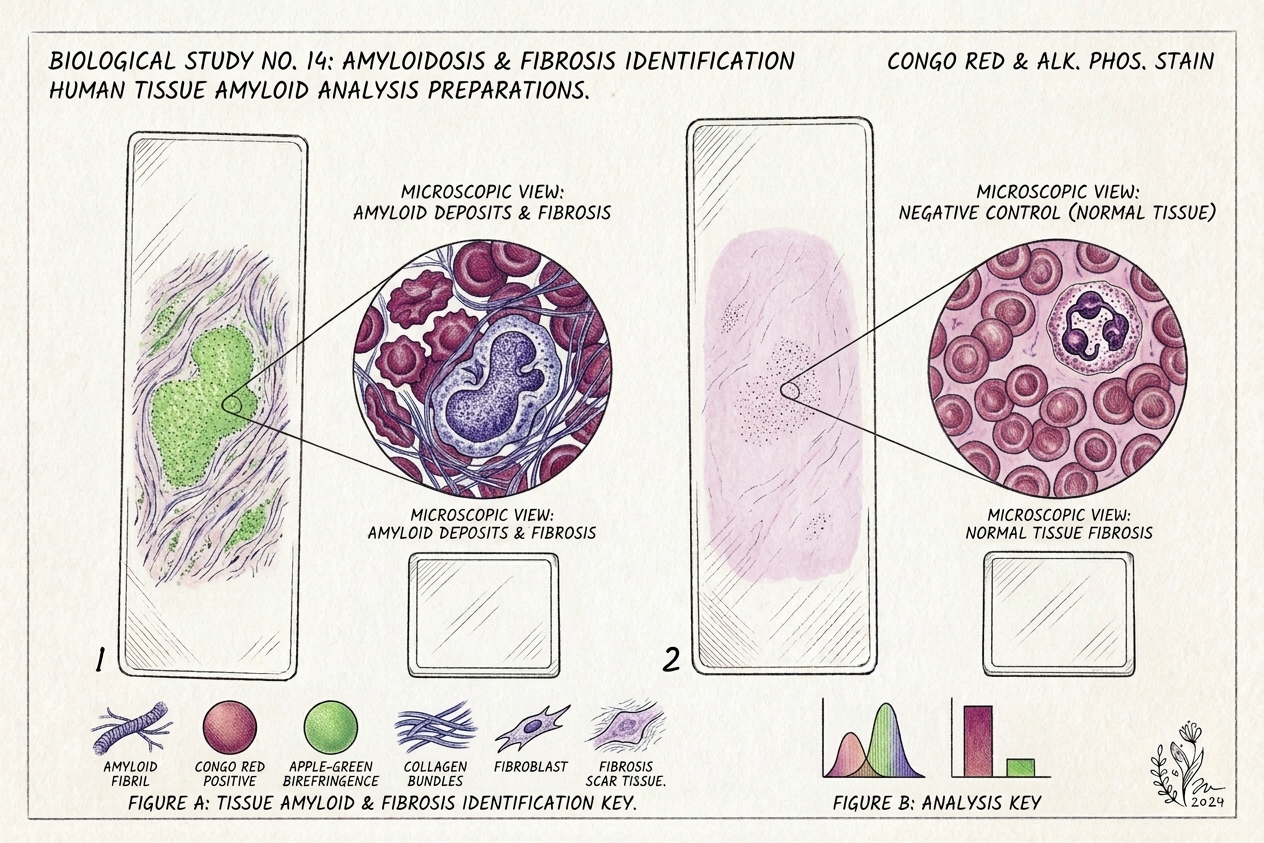
It's also worth knowing that amyloid isn't always a malfunction. Amyloid-beta may work as an antimicrobial defense, as explained in amyloid-beta as immune defense.
How does this connect to microclots?
Fibrinogen normally helps build a temporary clot that the body later cuts apart. Several research groups have reported amyloid-like fibrin(ogen) deposits and impaired fibrinolysis in Long COVID, summarized in our overview of fibrin amyloid microclots research.
The review highlights a 2025 observational study of 88 people that found more fluorescent microclots in the Long COVID group, linked to neutrophil extracellular traps (NETs) (Thierry et al., 2025). We walk through it in microclots and NETs in Long COVID.
There are limits. The study was small, its healthy comparison groups also showed some microclot signals, and it can't separate the effects of infection, vaccination, illness severity or selection. Vaccination status alone can't tell us what caused a clot signal. The overlap with post-vaccine findings is discussed in post-vaccination microclots and fibrinolysis.
The review also discusses embalmer surveys and spectroscopy of unusual postmortem fibrous casts. The authors acknowledge major gaps: the casts lacked donor exposure histories, protein-specific identification, matched controls and ultrastructural confirmation. Moving from circulating microclots to large postmortem casts is a hypothesis, not an established pathway.
What about "transcriptional instability"?
These claims mix different kinds of findings that aren't interchangeable:
- Detecting RNA or a protein doesn't automatically show it's still biologically active.
- A change in gene expression doesn't automatically mean permanent DNA damage.
- Finding a sequence in tumor DNA from one case doesn't prove vaccination caused genomic integration or cancer.
- A case report can flag a signal worth studying, but it can't estimate risk or show cause and effect.
The transcriptional-instability model is a proposed synthesis. It needs independent replication, proper controls, direct tissue measurements and studies designed to test causation.
What the review gets right
It's a useful map of the research, and it correctly stresses that:
- "prion-like" and "classical prion" aren't synonyms
- some spike sequences form amyloid in lab conditions
- cutting spike can expose aggregation-prone fragments
- coronavirus biology can stress the cell's folding machinery
- specific spike-derived fibrils can change fibrin behavior in vitro
- cross-seeding is plausible and deserves direct testing
What the review does not show
The review does not:
- report a new experiment, clinical trial or patient cohort
- prove that intact spike is a self-replicating prion
- show the full proposed pathway inside a living person
- establish that spike causes Alzheimer's disease or Creutzfeldt-Jakob disease
- prove that vaccination caused the microclots seen in an observational cohort
- prove that unusual postmortem casts are amyloid or vaccine-derived
- settle the origin of SARS-CoV-2; the review asserts a lab origin, but its cited material doesn't make that settled fact
- show that nattokinase, bromelain, serrapeptase or personalized ITI-PES peptides improve outcomes in people with persistent symptoms
That last point matters. Breaking down a protein in a test tube isn't the same as showing an oral supplement reaches the right tissue, works at a safe dose and helps more than it harms. Our review of nattokinase and lumbrokinase for microclots covers what the enzyme evidence does and doesn't support.
Can an amyloid test tell you if spike is acting like a prion?
No single test can. Alzheimer's tests look for brain amyloid-beta with PET scans, spinal fluid, or plasma amyloid-beta 42/40 and p-tau. Prion disease is assessed with tools like RT-QuIC. Our guide to the types of amyloid tests lays out what each one measures.
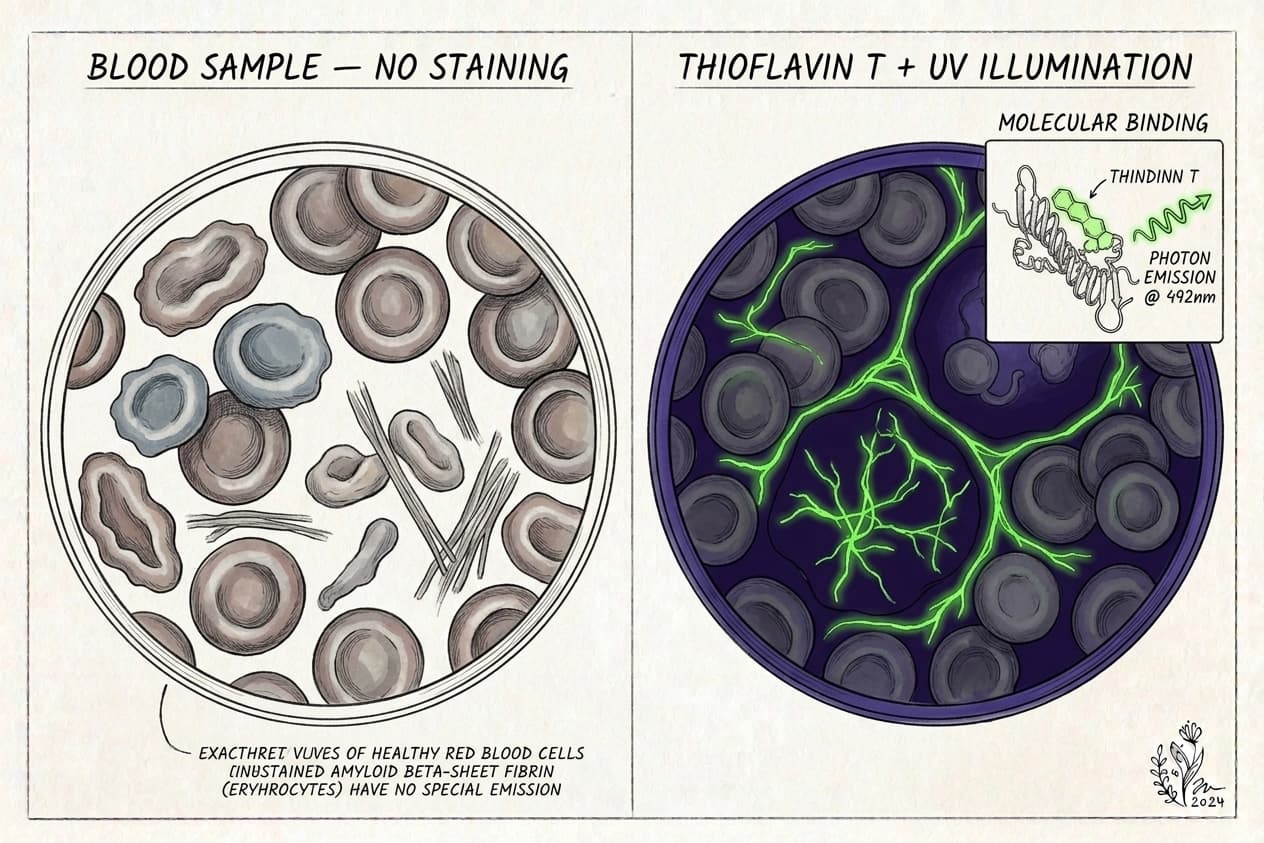
The lab method behind much of the spike amyloid research is Thioflavin T staining, explained in our amyloid fibril test guide. Our amyloid fibrin test applies ThT fluorescence microscopy to a dried blood sample to look at fibrin amyloid microclots. It isn't an Alzheimer's or prion test, doesn't measure spike protein and isn't a diagnosis; a clinician should interpret the report.
A simpler way to see it
Imagine every cell has a workshop where long ribbons are folded into useful tools. Spike is one ribbon the workshop may handle during infection or after vaccination. The review says that if the workshop gets stressed, or a ribbon is cut or read wrong, some pieces might come out with sticky edges.
Those pieces may pile up and give other ribbons, including brain and blood proteins, a place to start piling too. Scientists have shown parts of this story in computers, test tubes and cells. They haven't watched the whole story happen inside a person.
The bottom line
The strongest evidence is preclinical. Specific spike fragments form amyloid in the lab, and some interfere with fibrin formation or breakdown. Cell stress and ribosomal errors offer plausible ways abnormal fragments could arise.
The bigger clinical story, with persistent cross-seeding across organs, progressive neurodegeneration, transcriptional instability, a continuum from microclots to postmortem casts and effective enzyme treatment, hasn't been shown as one causal pathway in humans. The honest conclusion is neither dismissal nor certainty: the mechanism is testable, and the clinical claims need much stronger evidence.
This article is educational and doesn't diagnose illness or recommend treatment. The featured paper is a narrative review, and many of its proposed links remain preclinical or unconfirmed in humans.
Frequently asked questions
What's the difference between a prion and a prion-like protein?
A classical prion is a misfolded protein that converts normal copies of the same protein into its abnormal shape and can transmit disease, as in Creutzfeldt-Jakob disease. Prion-like is a looser label for proteins with aggregation-prone regions or that help other proteins misfold. Spike has been described as prion-like, not as a proven classical prion.
Does spike protein cause tau tangles?
That hasn't been shown in people. The 2026 review proposes that spike fragments could cross-seed tau, drawing on computational, biochemical and cell-model studies. No study has followed spike exposure through to tau pathology in a living human, so it remains a hypothesis that needs direct testing.
Who wrote the 2026 spike prion-like domain review?
The review was written by Catanzaro, McCullough and Hulscher and published in the International Journal of Innovative Research in Medical Science in September 2026. It's a narrative review, meaning the authors gathered and interpreted earlier studies rather than running new experiments or a clinical trial.
Can mRNA vaccines make unintended proteins?
A 2023 Nature study found that N1-methylpseudouridine in mRNA can cause some ribosomes to slip and make small amounts of +1 frameshifted protein, and vaccinated people mounted immune responses to those products. The study didn't report illness from them. The review uses this finding as one possible source of abnormal fragments.
Sources
- Recombinant SARS-CoV-2 Spike Protein and Prion-Like Domains: Persistent Cross-Seeding of Amyloid-β and Tau, Transcriptional Instability, and Tissue Dysfunction. International Journal of Innovative Research in Medical Science, 2026
- Amyloidogenesis of SARS-CoV-2 Spike Protein. Journal of the American Chemical Society, 2022
- SARS-CoV-2 Spike Protein Amyloid Fibrils Impair Fibrin Formation and Fibrinolysis. Biochemistry, 2025
- Prion-like Domains in Spike Protein of SARS-CoV-2 Differ across Its Variants and Enable Changes in Affinity to ACE2. Microorganisms, 2022
- Manipulation of the unfolded protein response: A pharmacological strategy against coronavirus infection. PLOS Pathogens, 2021
- N1-methylpseudouridylation of mRNA causes +1 ribosomal frameshifting. Nature, 2023
- Structural basis of ribosomal frameshifting during translation of the SARS-CoV-2 RNA genome. Science, 2021
- Circulating Microclots Are Structurally Associated With Neutrophil Extracellular Traps and Their Amounts Are Elevated in Long COVID Patients. Journal of Medical Virology, 2025
At-Home Amyloid Test
Want difficult spike-protein research explained clearly?
Explore our plain-English research guides, and discuss medical decisions with a qualified clinician.
Next steps
- Spike Protein and Alzheimer's: The Spike Amyloid Cross-Seeding StudySpike protein amyloid sped up misfolding of Alzheimer's amyloid-beta and prion protein in a lab study. What it shows about the brain, and what it doesn't.
- Types of Amyloid Tests: Blood Tests, PET, CSF, Biopsy and MicroclotsCompare the types of amyloid tests: Alzheimer's blood tests, amyloid PET, spinal fluid, amyloidosis biopsy and fibrin amyloid microclot microscopy.
- Spike Protein Amyloid Fibrils: How Spike685 Makes Clots Resist LysisHow spike protein amyloid fibrils change fibrin clots: what the 2025 Linköping study found for Spike601 and Spike685, and what it cannot yet tell us.

Tim Ottowitz
Founder, CovidVaccineDetox
Tim Ottowitz translates complex biomedical research into clear, carefully sourced explanations for everyday readers.
Keep reading
Amyloid-Beta Antimicrobial Peptide: Amyloid as an Immune Defense
Is amyloid-beta an antimicrobial peptide? How amyloid works as immune defense, what Meytal Landau's lab showed, and where spike protein fits in.
Amyloid Fibril Test: Methods Used to Detect Amyloid Fibrils
How an amyloid fibril test works: Thioflavin T, Congo red, electron microscopy, X-ray diffraction and seeding assays compared, with which are clinical.
COVID Vaccine Harms: What the 2025 JPandS Review Argues
A plain-language walkthrough of the 2025 JPandS review on COVID vaccine harms: what it claims, which sources hold up, and where the evidence is weak.